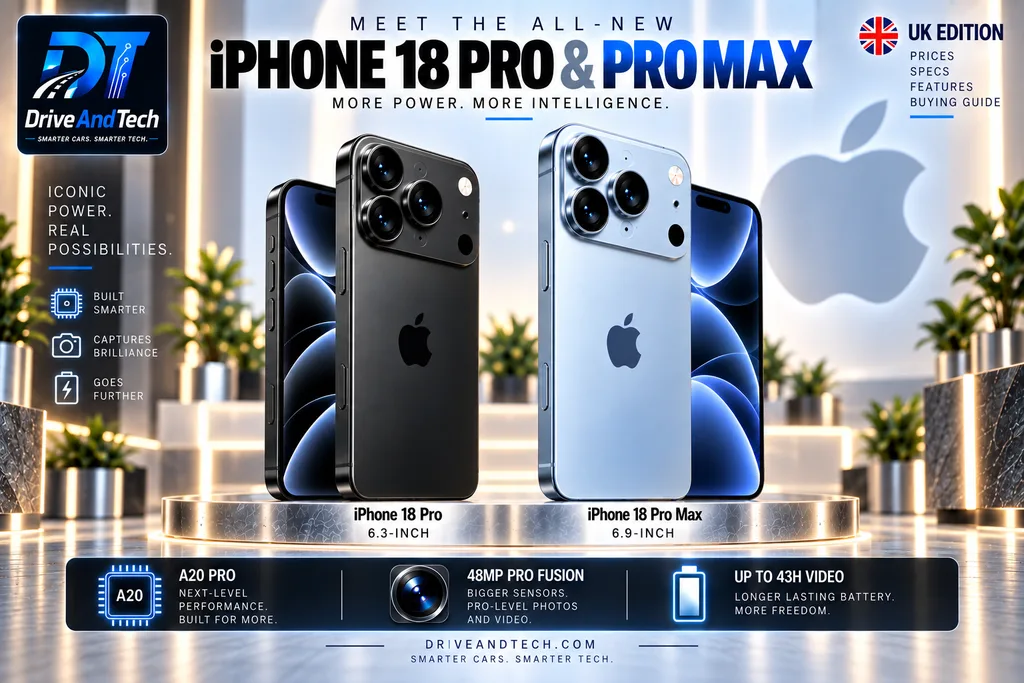
Apple’s new flagship iPhones have arrived. The iPhone 18 Pro and iPhone 18 Pro Max bring some of the most significant upgrades to Apple’s Pro range in recent years, with major changes to the camera system, performance, battery life and artificial intelligence.
At the centre of the upgrade is Apple’s new A20 Pro chip, paired with a next-generation vapour chamber designed to sustain performance during demanding workloads. Photography also takes a notable step forward with a new 48MP Fusion Main camera featuring variable aperture, giving users greater control over light and depth of field.
There is also a redesigned Dynamic Island, faster charging, four finishes and Apple’s new Siri AI experience. The Pro Max goes further on endurance, with Apple claiming up to 43 hours of video playback.
But these upgrades come at premium prices. In the UK, the iPhone 18 Pro starts at £1,199, while the iPhone 18 Pro Max starts at £1,299.
In this DriveAndTech guide, we examine what has genuinely changed, how the two models compare, and what prospective buyers should know before choosing between them.
Affiliate Disclosure
DriveAndTech may earn a commission if you purchase through selected links in this article, at no additional cost to you. This does not influence our editorial analysis, product comparisons or recommendations. We aim to provide independent information to help you make a more informed buying decision.
Quick Answer: What’s New With iPhone 18 Pro & Pro Max?
The iPhone 18 Pro and Pro Max UK launch brings meaningful upgrades in five key areas: cameras, performance, battery life, charging and AI.
Both models are powered by Apple’s new A20 Pro chip, featuring a 6-core CPU, 7-core GPU and Dual 16-core Neural Engine. A next-generation vapour chamber is designed to improve thermal management and sustain performance during intensive gaming, creative work and AI tasks.
The headline camera upgrade is a 48MP Pro Fusion system. Its new 48MP Fusion Main camera introduces variable aperture, with four settings from ƒ/1.48 to ƒ/4.0, while 48MP Ultra Wide and 48MP Telephoto cameras complete the rear system. An 18MP Center Stage camera handles selfies and video calls.
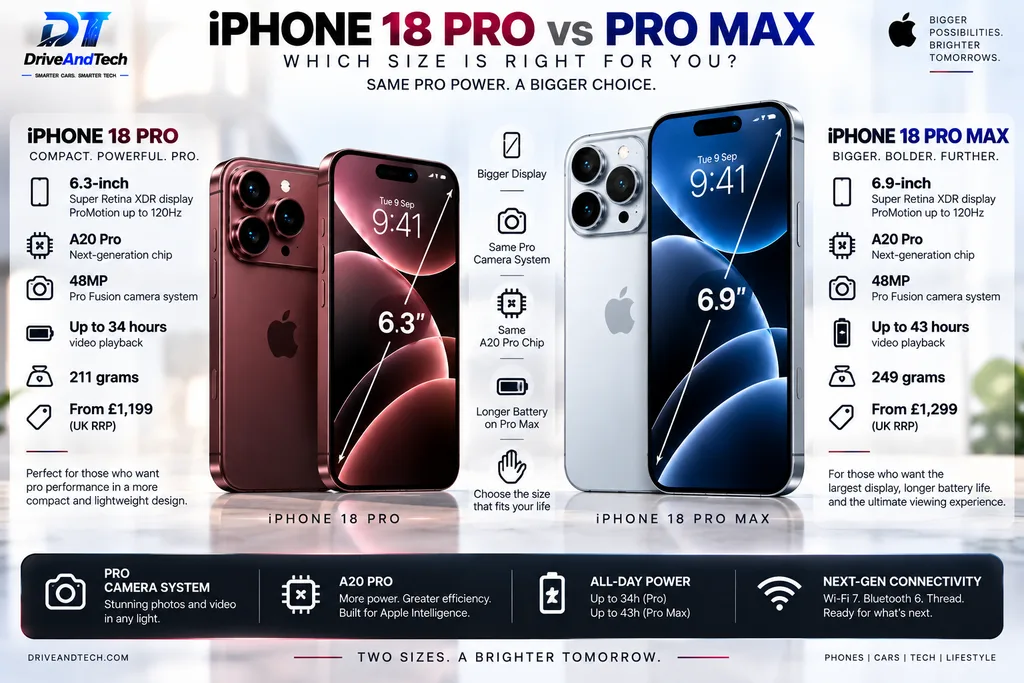
Size remains one of the biggest differences. The iPhone 18 Pro has a 6.3-inch Super Retina XDR OLED display, while the Pro Max increases this to 6.9 inches. Both support ProMotion up to 120Hz.
Battery life is another major distinction. Apple rates video playback at up to 34 hours on the Pro and 43 hours on the Pro Max. Compatible wired charging can also reach 50% in around 15 minutes.
For buyers, the choice is therefore less about sacrificing core Pro features and more about deciding whether the Pro Max’s larger display and longer battery life justify its additional size, weight and price.
iPhone 18 Pro & Pro Max UK Price, Release Date and Availability
Apple announced the iPhone 18 Pro and iPhone 18 Pro Max on 9 September 2026, with pre-orders opening in the UK on 12 September. Both models are scheduled to become available from Friday, 18 September 2026 through Apple and participating UK retailers and mobile networks.
The iPhone 18 Pro starts at £1,199, while the larger iPhone 18 Pro Max starts at £1,299. Both models now begin with 256GB of storage, with 512GB, 1TB and 2TB configurations available for buyers who need additional space.
UK Starting Prices
| Model | Starting Storage | UK Starting Price |
|---|---|---|
| iPhone 18 Pro | 256GB | £1,199 |
| iPhone 18 Pro Max | 256GB | £1,299 |
That creates a £100 starting-price difference between the two models. Because their core processor and Pro camera platform are closely related, the extra cost of the Pro Max is primarily associated with its larger 6.9-inch display, bigger physical format and longer quoted battery life.
Apple offers the new Pro models in Black, Silver, Glacier and Burgundy.
For UK buyers considering an upgrade, it is worth comparing Apple’s outright pricing with network contracts, trade-in values and retailer promotions rather than looking only at the headline purchase price. The best overall deal may vary considerably depending on your existing phone and preferred mobile plan.
iPhone 18 Pro vs Pro Max: Specs at a Glance
The iPhone 18 Pro and Pro Max share most of their core technology, including the A20 Pro chip, Pro camera system and storage options. The biggest everyday differences are screen size, physical dimensions, weight and battery life.
| Specification | iPhone 18 Pro | iPhone 18 Pro Max |
|---|---|---|
| Display | 6.3-inch Super Retina XDR OLED | 6.9-inch Super Retina XDR OLED |
| Refresh Rate | ProMotion up to 120Hz | ProMotion up to 120Hz |
| Processor | A20 Pro | A20 Pro |
| Main Camera | 48MP Fusion, variable aperture | 48MP Fusion, variable aperture |
| Ultra Wide | 48MP | 48MP |
| Telephoto | 48MP | 48MP |
| Front Camera | 18MP Center Stage | 18MP Center Stage |
| Storage | 256GB–2TB | 256GB–2TB |
| Weight | 211g | 249g |
| Video Playback | Up to 34 hours* | Up to 43 hours* |
| Starting Price | £1,199 | £1,299 |
*Apple-rated video playback figures for the relevant UK configurations; actual battery life varies with use.
On paper, Apple has avoided making the smaller Pro feel like a substantially less capable flagship. That means the buying decision comes down largely to whether you prefer the more manageable 6.3-inch Pro or value the larger screen and additional endurance of the Pro Max enough to accept its extra size, weight and cost.
The Biggest iPhone 18 Pro Upgrades
The iPhone 18 Pro and Pro Max UK launch is more than a routine processor refresh. Apple has concentrated its biggest changes on areas that directly affect everyday use: photography, sustained performance, battery life, display usability and artificial intelligence.
Here are the upgrades that matter most.
1. Refined Design, Brighter Display and a Smaller Dynamic Island
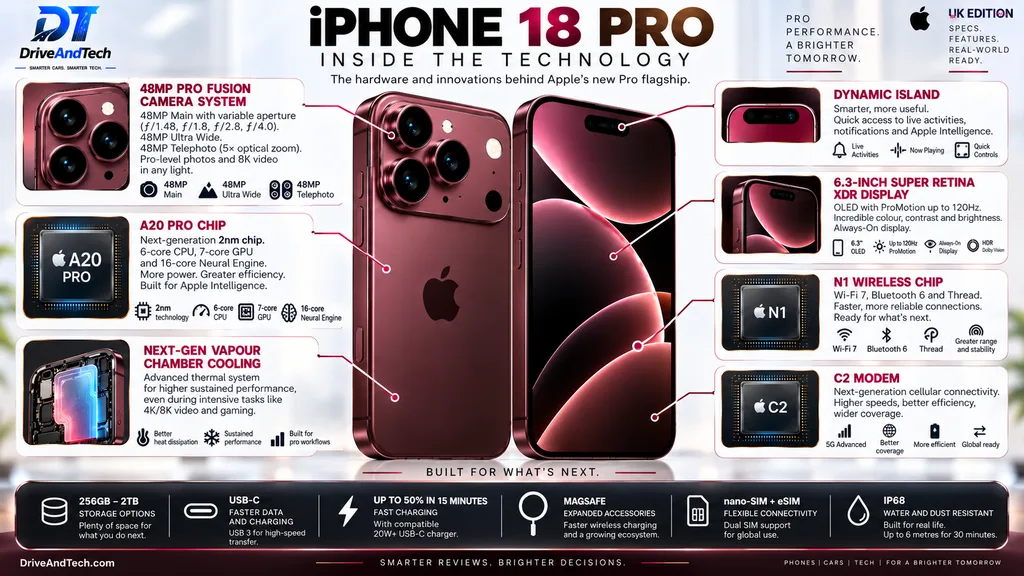
Apple continues with two sizes: a 6.3-inch iPhone 18 Pro and a 6.9-inch iPhone 18 Pro Max. Both use Super Retina XDR OLED displays with ProMotion adaptive refresh rates up to 120Hz, Always-On functionality and up to 3,000 nits of peak outdoor brightness.
The aluminium unibody construction is protected by Ceramic Shield 2 at the front and Ceramic Shield at the rear, while IP68 water and dust resistance remains.
One of the more noticeable interface changes is the smaller Dynamic Island. Apple has redesigned it to occupy less display space while becoming more useful, including the ability to show up to three Live Activities simultaneously.
It is not a radical visual reinvention of the iPhone, but it represents the kind of refinement that should be noticeable during everyday use.
2. A Much More Flexible 48MP Pro Camera System
The camera is arguably the headline upgrade.
Both models feature a 48MP Pro Fusion camera system, led by a new 48MP Fusion Main camera with variable aperture. For the first time on an iPhone, users can select between ƒ/1.48, ƒ/1.8, ƒ/2.8 and ƒ/4.0 apertures.
That matters because aperture affects both the amount of light entering the camera and depth of field. A wider setting can be useful in lower light and for stronger subject separation, while narrower apertures provide greater creative control over how much of a scene appears in focus.
The Main camera is joined by a 48MP Fusion Ultra Wide and 48MP Fusion Telephoto. The telephoto provides a native 4x perspective, while Apple also offers an 8x optical-quality option and up to 40x digital zoom.
Apple has added more manual-style Pro controls too, including aperture, shutter speed, white balance and histogram viewing. Combined with ProRAW and advanced video features, the iPhone 18 Pro is increasingly aimed not only at casual smartphone photographers but also at creators who want greater control without carrying a dedicated camera.
3. A20 Pro Brings More Power and Better Cooling
Inside both phones is the new A20 Pro, manufactured using a 2-nanometre process. It combines a 6-core CPU, 7-core GPU with Neural Accelerators and a Dual 16-core Neural Engine.
Raw processing power is only part of the story. Apple has redesigned the thermal system with a next-generation vapour chamber that has three times the surface area of the previous generation.
Better cooling matters because a powerful processor can reduce its performance when heat builds up during demanding workloads. Apple says the combination of A20 Pro and the new thermal system enables up to 40% higher sustained performance compared with the previous generation.
That is an Apple performance claim rather than a DriveAndTech benchmark result, so independent testing will be important. Nevertheless, the engineering changes are particularly relevant for gaming, video editing and intensive AI workloads where sustained performance matters more than a brief benchmark peak.
4. Battery Life Takes a Significant Step Forward
Battery endurance is another major focus, especially on the Pro Max.
For UK configurations, Apple rates the iPhone 18 Pro for up to 34 hours of video playback and the Pro Max for up to 43 hours. Typical-use figures are quoted at up to 23 and 29 hours respectively.
Charging has improved as well. With compatible equipment, Apple says either model can reach 50% charge in around 15 minutes using a compatible 60W or higher USB-C power adapter. MagSafe can reach 50% in around 30 minutes when paired with compatible hardware.
As always, manufacturer battery figures are useful for comparison but should not be interpreted as guaranteed real-world endurance. Screen brightness, mobile signal, camera use, gaming and background activity can all change how long a phone lasts.
Still, the combination of a more efficient chip, revised battery design and faster charging makes battery life one of the more meaningful upgrades of this generation.
5. Siri AI, Apple Intelligence and New Connectivity
The iPhone 18 Pro generation also places AI much closer to the centre of the experience.
Both phones ship with iOS 27 and support the next generation of Apple Intelligence, including Siri AI. Apple describes the new Siri as more personal, conversational and context-aware, with greater ability to understand information across apps and assist with more complex requests.
A20 Pro’s Dual 16-core Neural Engine is designed specifically to accelerate on-device AI workloads. Apple continues to emphasise privacy, using on-device processing where possible and Private Cloud Compute for more demanding requests.
Connectivity has been upgraded too. Apple’s N1 wireless chip brings support for Wi-Fi 7, Bluetooth 6 and Thread, while the new C2 cellular modem system is designed to improve mobile connectivity and efficiency.
Not every AI feature will necessarily matter to every buyer, and Siri AI is initially rolling out in beta. But taken together, the new silicon, connectivity and software show where Apple sees the iPhone heading: increasingly powerful on-device intelligence integrated into everyday tasks rather than AI existing as a separate feature.
iPhone 18 Pro: Full Analysis
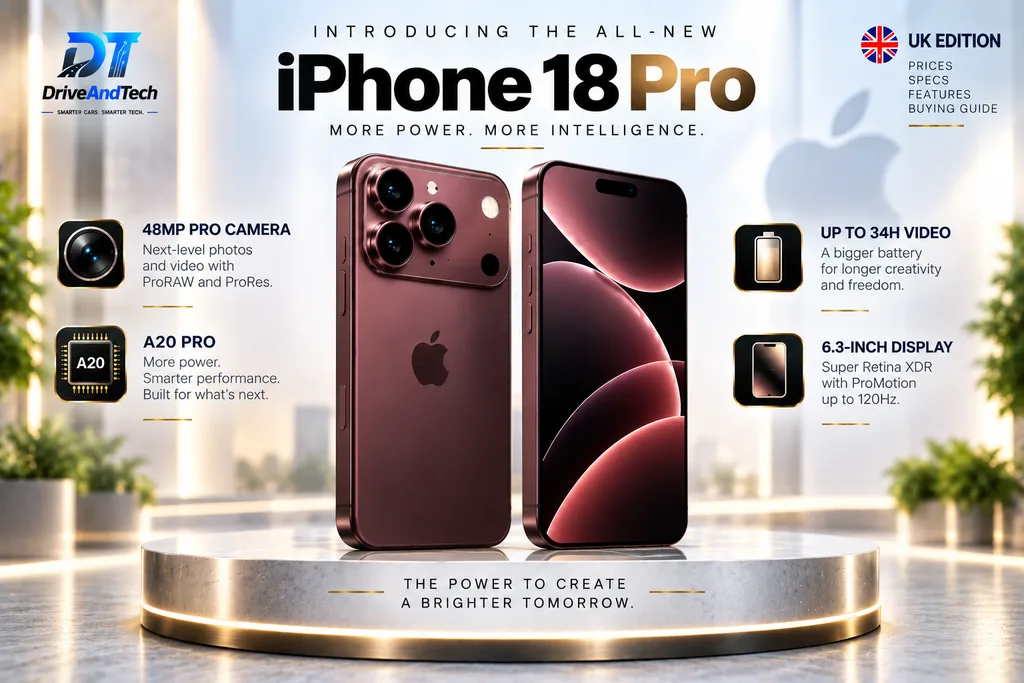
The iPhone 18 Pro is arguably the more balanced of Apple’s two new flagship phones. Starting at £1,199 in the UK, it combines Apple’s latest A20 Pro performance, new 48MP Pro Fusion camera system and premium display technology in a smaller and lighter body than the Pro Max.
Crucially, choosing the smaller model does not mean accepting a substantially weaker processor or camera system. Most of the differences between the two phones come down to display size, physical dimensions, weight and battery endurance.
iPhone 18 Pro Technical Specifications
| Specification | iPhone 18 Pro |
|---|---|
| Display | 6.3-inch Super Retina XDR OLED |
| Resolution | 2622 × 1206 pixels, 460ppi |
| Refresh rate | ProMotion adaptive refresh up to 120Hz |
| Brightness | Up to 3,000 nits peak outdoor brightness |
| Processor | A20 Pro – 6-core CPU, 7-core GPU |
| AI hardware | Dual 16-core Neural Engine |
| Main camera | 48MP Fusion Main with variable aperture |
| Ultra Wide | 48MP Fusion Ultra Wide |
| Telephoto | 48MP Fusion Telephoto, native 4x |
| Front camera | 18MP Center Stage |
| Storage | 256GB / 512GB / 1TB / 2TB |
| Battery | Up to 34 hours video playback* |
| Wired fast charging | Up to 50% in around 15 minutes with compatible 60W+ AVS adapter* |
| MagSafe charging | Up to 25W |
| Qi2 charging | Up to 25W |
| Charging/data port | USB-C; USB 3 up to 10Gb/s; DisplayPort |
| Mobile connectivity | 5G |
| Wi-Fi | Wi-Fi 7 with 2×2 MIMO |
| Bluetooth | Bluetooth 6 |
| Other wireless | Thread, NFC, second-generation Ultra Wideband |
| Cellular modem | Apple C2 |
| SIM – UK model | Dual SIM: nano-SIM + eSIM; Dual eSIM supported |
| Security | Face ID |
| Water/dust resistance | IP68 – up to 6m for 30 minutes under IEC 60529 |
| Dimensions | 150 × 71.9 × 8.75mm |
| Weight | 211g |
| UK starting price | £1,199 |
*Apple laboratory figures. Actual charging time and battery life vary according to equipment, settings, network conditions and use.
Display and Everyday Usability
The 6.3-inch Super Retina XDR OLED display is one of the strongest reasons to consider the Pro rather than automatically moving to the Pro Max. You still get ProMotion up to 120Hz, Always-On functionality, HDR and up to 3,000 nits of peak outdoor brightness, but in a body that should be considerably easier to carry.
At 211g, the Pro is 38g lighter than the Pro Max. That matters for people who frequently use their phone one-handed or simply don’t want a 6.9-inch device occupying their pocket.
Cameras: Pro Max Capability Without the Pro Max Size
Photography is where the iPhone 18 Pro becomes particularly compelling.
The new 48MP Fusion Main camera introduces variable aperture, with ƒ/1.48, ƒ/1.8, ƒ/2.8 and ƒ/4.0 settings. It is joined by a 48MP Ultra Wide and 48MP Telephoto with a native 4x perspective.
Because Apple gives the Pro essentially the same headline rear-camera platform as the Pro Max, buyers no longer need to choose the largest model simply to access the flagship camera experience.
The 18MP Center Stage front camera, ProRAW support and expanded manual-style controls further strengthen its appeal to photographers and content creators.
A20 Pro, Cooling and Connectivity
The 2nm A20 Pro combines a 6-core CPU, 7-core GPU and Dual 16-core Neural Engine. Apple has also introduced a next-generation vapour chamber intended to maintain performance for longer during demanding gaming, video editing and AI workloads.
Connectivity is equally comprehensive. The Apple-designed N1 wireless chip supports Wi-Fi 7, Bluetooth 6 and Thread, while the C2 cellular modem handles 5G connectivity.
USB-C supports USB 3 transfer speeds up to 10Gb/s and DisplayPort, an important detail for creators moving large ProRAW photographs or video files and users connecting the phone to compatible external displays and storage.
Charging, MagSafe and Battery Life
Apple rates the iPhone 18 Pro for up to 34 hours of video playback.
More importantly for everyday use, wired fast charging can reach approximately 50% in 15 minutes when using a compatible 60W-capable or higher AVS power adapter and USB-C cable.
Wireless charging supports both MagSafe and Qi2 at up to 25W. Apple says MagSafe can reach around 50% in 30 minutes when paired with a compatible 35W or higher adapter.
Those figures come from Apple-controlled testing rather than independent DriveAndTech testing, but the combination of longer endurance and faster top-ups should make charging considerably less restrictive for heavy users.
SIM, 5G and UK Buyers
UK buyers get Dual SIM support through one nano-SIM and one eSIM, with Dual eSIM also supported.
This is worth highlighting because iPhone specifications can vary by market. UK customers therefore retain the flexibility of using a physical nano-SIM while also having eSIM functionality.
DriveAndTech Verdict
The iPhone 18 Pro’s strongest quality is balance.
It offers Apple’s flagship processor, sophisticated new camera system, high-end connectivity, fast wired and wireless charging and up to 2TB of storage without requiring buyers to accept the Pro Max’s substantially larger 249g body.
Its £1,199 starting price is unquestionably premium, and owners of very recent Pro iPhones may struggle to justify another upgrade.
But for someone specifically choosing between the iPhone 18 Pro and Pro Max, the smaller Pro sacrifices surprisingly little where performance and photography are concerned.
Best for: buyers who want Apple’s highest-end technology in the more manageable of its two Pro form factors.
iPhone 18 Pro Max: Full Analysis
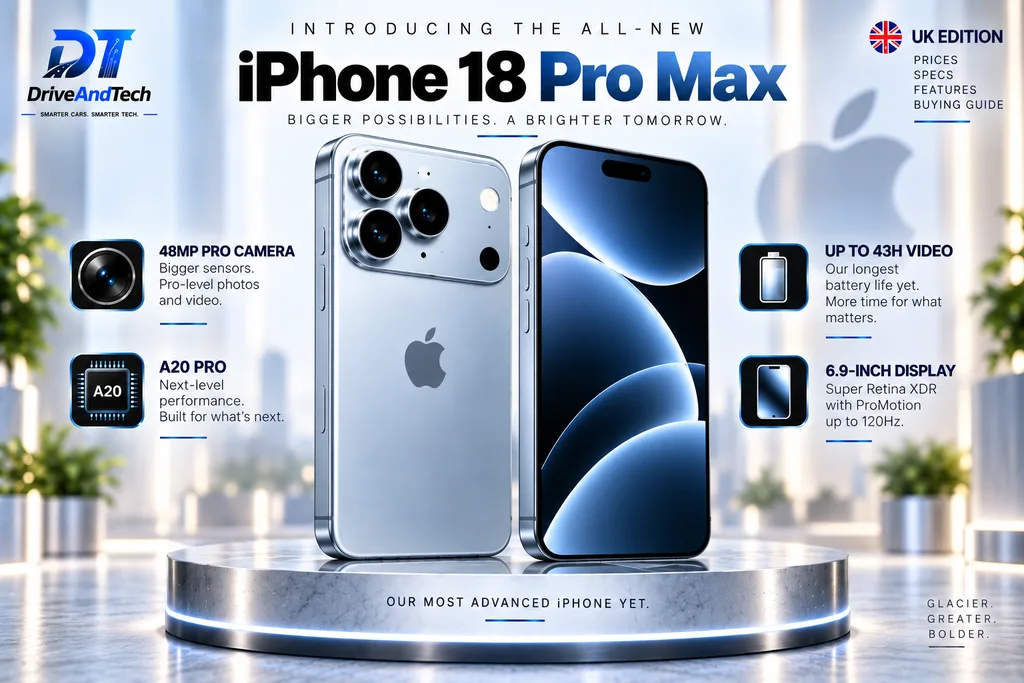
The iPhone 18 Pro Max is Apple’s no-compromise flagship for buyers who prioritise screen space and battery endurance. Starting at £1,299 in the UK, it combines the same A20 Pro performance and advanced 48MP Pro Fusion camera system as the smaller Pro with a substantially larger 6.9-inch display and longer battery life.
Importantly, the Pro Max is not a higher-performance version of the Pro. Both models share most of their core technology. What the additional £100 primarily buys is a larger display, bigger physical format and greater battery endurance.
iPhone 18 Pro Max Technical Specifications
| Specification | iPhone 18 Pro Max |
|---|---|
| Display | 6.9-inch Super Retina XDR OLED |
| Resolution | 2868 × 1320 pixels, 460ppi |
| Refresh rate | ProMotion adaptive refresh up to 120Hz |
| Brightness | Up to 3,000 nits peak outdoor brightness |
| Processor | A20 Pro – 6-core CPU, 7-core GPU |
| AI hardware | Dual 16-core Neural Engine |
| Main camera | 48MP Fusion Main with variable aperture |
| Ultra Wide | 48MP Fusion Ultra Wide |
| Telephoto | 48MP Fusion Telephoto, native 4x |
| Front camera | 18MP Center Stage |
| Storage | 256GB / 512GB / 1TB / 2TB |
| Battery | Up to 43 hours video playback on the relevant UK configuration* |
| Wired fast charging | Up to 50% in around 15 minutes with compatible 60W+ AVS adapter* |
| MagSafe charging | Up to 25W |
| Qi2 charging | Up to 25W |
| Charging/data port | USB-C; USB 3 up to 10Gb/s; DisplayPort |
| Mobile connectivity | 5G |
| Wi-Fi | Wi-Fi 7 with 2×2 MIMO |
| Bluetooth | Bluetooth 6 |
| Other wireless | Thread, NFC, second-generation Ultra Wideband |
| Cellular modem | Apple C2 |
| SIM – UK model | Dual SIM: nano-SIM + eSIM; Dual eSIM supported |
| Security | Face ID |
| Water/dust resistance | IP68 – up to 6m for 30 minutes under IEC 60529 |
| Dimensions | 163.4 × 78 × 8.75mm |
| Weight | 249g |
| UK starting price | £1,299 |
*Apple laboratory figures. Battery life and charging times vary according to use, configuration, network conditions, temperature and charging equipment.
Display: The Main Reason to Choose the Pro Max
The 6.9-inch Super Retina XDR OLED display is the defining feature of the Pro Max. It gives you considerably more viewing area than the 6.3-inch Pro while retaining ProMotion adaptive refresh up to 120Hz, Always-On functionality and the same premium display technologies.
That extra space becomes genuinely useful when watching films, gaming, editing photographs or video, reading documents and working with applications containing dense controls.
For creators in particular, the combination of the large display and Apple’s Pro camera tools makes the Pro Max feel more like a compact creative workstation.
But there is a clear ergonomic cost.
At 249g, the Pro Max is 38g heavier than the Pro. Its 163.4mm height and 78mm width also make it significantly more demanding for one-handed use. Buyers moving from a standard-sized iPhone should therefore consider the physical dimensions as seriously as the specifications.
Cameras: The Same Flagship System as the Pro
The Pro Max features Apple’s 48MP Pro Fusion camera system, including the new 48MP Fusion Main camera with variable aperture.
Users can select between ƒ/1.48, ƒ/1.8, ƒ/2.8 and ƒ/4.0 settings, providing more direct control over light and depth of field. The Main camera is accompanied by a 48MP Fusion Ultra Wide and 48MP Fusion Telephoto with a native 4x perspective.
The 18MP Center Stage front camera, ProRAW support and expanded professional controls further strengthen the phone’s credentials for photography and content creation.
However, this is important for prospective buyers: you do not need the Pro Max to get Apple’s headline camera system. The smaller Pro receives essentially the same core camera hardware.
The Pro Max advantage is therefore not superior camera specifications, but the larger display on which to frame, review and edit your images and video.
A20 Pro, Cooling and Sustained Performance
The Pro Max is powered by the same 2nm A20 Pro as the Pro, combining a 6-core CPU, 7-core GPU and Dual 16-core Neural Engine.
Apple pairs this with its next-generation vapour chamber. The company says the new thermal system has three times the surface area of the previous generation and enables up to a 40% improvement in sustained performance compared with the iPhone 17 Pro generation.
That is an Apple claim rather than an independently measured DriveAndTech result, but sustained performance is particularly relevant on a device such as the Pro Max. Long gaming sessions, high-resolution video work and demanding AI tasks are precisely the workloads where effective thermal management matters.
Battery Life: The Pro Max’s Strongest Advantage
Battery endurance is arguably the most convincing reason to pay extra for the Pro Max.
Apple rates the relevant UK configuration for up to 43 hours of video playback, compared with 34 hours on the smaller Pro. Apple’s newer typical-use testing also demonstrates the emphasis placed on all-day endurance.
There is an important regional distinction. Apple says eSIM-only Pro Max models can reach up to 45 hours of video playback because removing the physical SIM hardware creates room for a larger battery. Those versions are sold in specified markets; the figure should not be confused with the relevant UK configuration.
Wired fast charging can reach approximately 50% in around 15 minutes with a compatible 60W-capable or higher AVS power adapter and suitable USB-C cable.
MagSafe and Qi2 wireless charging support up to 25W, while Apple says compatible MagSafe equipment can reach around 50% in approximately 30 minutes.
USB-C, 5G and Wireless Connectivity
The Pro Max is comprehensively equipped for connectivity.
USB-C supports USB 3 transfer speeds up to 10Gb/s and DisplayPort, making the port useful for more than charging. Creators working with large photographs or video files can transfer data to compatible storage considerably faster than with basic USB speeds, while DisplayPort support enables compatible external-display workflows.
Apple’s N1 networking chip provides Wi-Fi 7, Bluetooth 6 and Thread, while the new C2 cellular modem system handles 5G connectivity. NFC and second-generation Ultra Wideband are also included.
SIM and UK Buyers
UK buyers retain a physical nano-SIM slot alongside eSIM support, with Dual eSIM also available.
That distinction is particularly important on the Pro Max because Apple’s eSIM-only variants can have different battery specifications. UK shoppers should therefore use UK-specific specifications when comparing battery figures rather than assuming figures quoted for US or other eSIM-only versions apply directly.
DriveAndTech Verdict
The iPhone 18 Pro Max makes the strongest case for itself through screen size and battery endurance, not through exclusive processing power or camera hardware.
Its £1,299 starting price is only £100 above the Pro, which may make the upgrade attractive to buyers who already prefer large phones. But the bigger consideration is arguably the 249g weight and 6.9-inch form factor.
For frequent travellers, gamers, heavy media consumers and creators who spend hours working from their phone, those compromises can be worthwhile. The larger display improves content consumption and creation, while the additional battery capacity addresses one of the biggest concerns for intensive smartphone users.
For buyers who don’t need those advantages, the smaller Pro delivers almost all of the same flagship technology in a more manageable package.
Best for: heavy users, creators, gamers and buyers who prioritise the largest display and longest battery life in Apple’s Pro range.
iPhone 18 Pro vs Pro Max: What Are the Real Differences?
Despite their different sizes and prices, the iPhone 18 Pro and Pro Max are remarkably similar where performance matters. Both offer the A20 Pro chip, 48MP Pro Fusion camera system, ProMotion OLED display and the same core Apple Intelligence features.
The real differences come down to size, weight, battery life and price.
Size and Everyday Comfort
The iPhone 18 Pro combines a 6.3-inch display with a 211g body, making it the easier of the two to hold, carry and use one-handed.
The Pro Max increases the display to 6.9 inches and weighs 249g. That extra screen space is valuable for films, gaming, photo editing, reading and productivity, but the phone will also occupy more pocket space and can become less comfortable during prolonged one-handed use.
Battery Life
This is where the Pro Max establishes its strongest advantage.
Apple rates the UK iPhone 18 Pro for up to 34 hours of video playback, compared with 43 hours on the Pro Max. Real-world results will vary, but Apple’s figures indicate a meaningful endurance advantage for the larger model.
Camera and Performance
There is much less separating them here. Both receive the A20 Pro and Apple’s headline 48MP Pro Fusion camera system, including the variable-aperture Main camera.
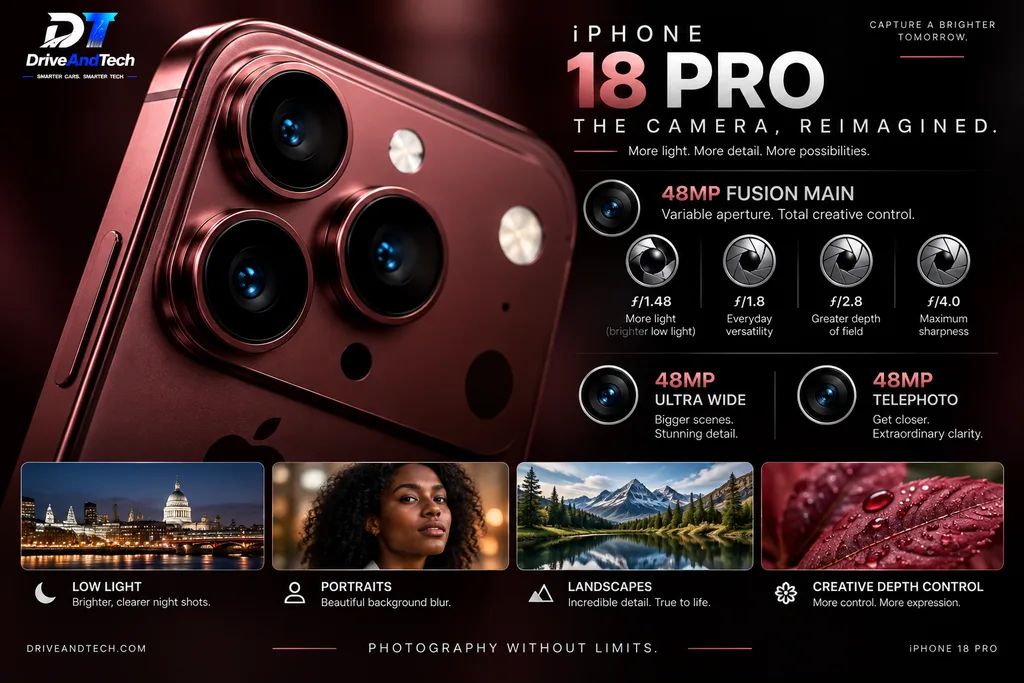
That is important: choosing the smaller Pro does not mean accepting a lower-tier processor or losing the flagship rear-camera platform.
Is the Pro Max Worth the Extra £100?
For buyers who regularly watch video, game, edit content or spend long days away from a charger, the additional £100 can be relatively easy to justify.
For everyone else, the iPhone 18 Pro arguably delivers more of the same flagship experience in a considerably easier-to-manage package.
The decision is therefore refreshingly straightforward: choose the Pro for portability and the Pro Max for maximum screen space and battery endurance.
iPhone 18 Pro vs iPhone 17 Pro: What Has Changed?
For existing iPhone owners, the more useful question is not simply whether the iPhone 18 Pro is impressive, it is whether Apple has changed enough to make upgrading worthwhile.
This year, several improvements stand out.
Camera Control Takes a Major Step Forward
The biggest change is the 48MP Fusion Main camera with variable aperture. Rather than relying on a fixed aperture, the iPhone 18 Pro can adjust between ƒ/1.48, ƒ/1.8, ƒ/2.8 and ƒ/4.0.
This gives the camera greater control over light and depth of field, while new Pro controls add manual adjustment of aperture, shutter speed and white balance. For photographers and video creators, this is a more meaningful change than simply increasing megapixels.
A20 Pro and Better Thermal Management
The iPhone 18 Pro replaces the previous-generation chip with the new 2nm A20 Pro, alongside a substantially redesigned vapour chamber.
Apple says the new thermal system has three times the surface area of the previous generation and, together with A20 Pro, can deliver up to 40% better sustained performance than iPhone 17 Pro. That claim still requires independent real-world verification, but it could matter particularly for prolonged gaming, video work and demanding AI tasks.
Battery, Charging and Everyday Usability
Apple has also concentrated on endurance and charging rather than treating them as secondary upgrades. Battery life increases across the Pro family, while compatible wired charging can reach 50% in around 15 minutes.
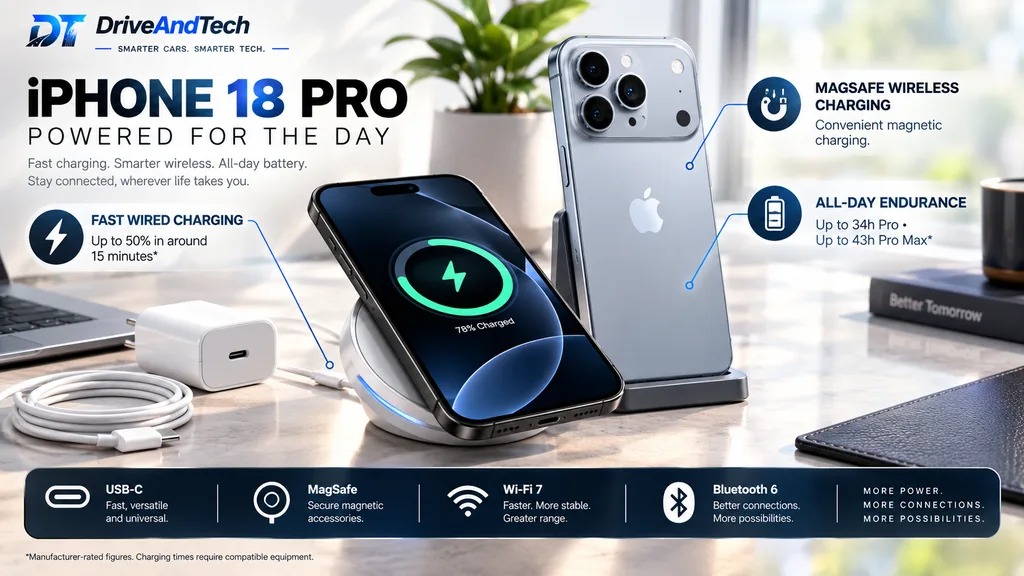
The redesigned Dynamic Island can now display up to three Live Activities simultaneously, while the new C2 modem and N1 wireless chip bring improvements to cellular connectivity, Wi-Fi 7 and Bluetooth 6.
Is It a Major Generational Upgrade?
For an iPhone 17 Pro owner, the answer depends heavily on priorities. The fundamental experience remains familiar, so upgrading after only one generation will not make sense for everyone.
However, variable-aperture photography, improved sustained performance, longer battery life, faster charging and expanded AI capability give the iPhone 18 Pro more substantial improvements than a simple annual chip refresh.
The strongest upgrade case is therefore likely to be for photography enthusiasts, demanding mobile gamers and creators or owners of older iPhones who can benefit from several generations of improvements at once.
Should You Upgrade to iPhone 18 Pro?
Whether the iPhone 18 Pro is worth upgrading to depends less on how impressive the new hardware looks and more on which iPhone you already own.
If You Have an iPhone 17 Pro or Pro Max
For most owners, there is no urgent need to upgrade after one year. The iPhone 17 Pro generation remains powerful, and much of the everyday iPhone experience will still feel familiar.
The case becomes stronger if you particularly want the new variable-aperture camera, improved sustained performance, faster charging or additional battery endurance. Apple says the iPhone 18 Pro Max, for example, gains up to six additional hours of video playback over the 17 Pro Max.
If You Have an iPhone 16 Pro or Pro Max
This is a more interesting decision. Two generations of improvements accumulate into a more substantial package, particularly for photography, battery life, thermal performance and AI.
However, if your current phone remains fast, its battery is healthy and its camera already meets your needs, keeping it for another year can still make financial sense.
If You Have an iPhone 15 Pro or Older
The upgrade becomes considerably easier to appreciate. You are moving across several generations of processor, camera, battery and software development rather than paying primarily for year-on-year improvements.
Owners of older non-Pro iPhones may notice an even larger change from the 120Hz ProMotion display, Pro camera system and flagship performance.
DriveAndTech Take
Don’t upgrade simply because the iPhone 18 Pro is newer. Upgrade when its improvements solve something your current iPhone no longer does well enough.
For recent Pro owners, that may require a specific reason. For people holding an older iPhone for several years, the iPhone 18 Pro and Pro Max UK launch presents a much more substantial step forward.
Which Should You Buy: iPhone 18 Pro or Pro Max?
Choosing between the iPhone 18 Pro and Pro Max is simpler this year because Apple gives both phones the same core A20 Pro performance and 48MP Pro Fusion camera system. You are mainly deciding how much phone you want to carry – and how much battery life you need.
Choose the iPhone 18 Pro If…
The iPhone 18 Pro is the better fit if you want flagship performance and cameras without an oversized handset. Its 6.3-inch display is still substantial, but the 211g body is noticeably lighter and easier to manage than the Pro Max.
It also saves you £100, with UK pricing starting at £1,199.
For most buyers who don’t specifically need the largest screen or longest battery life, the Pro offers the more balanced combination of power, portability and price.
Choose the iPhone 18 Pro Max If…
Choose the iPhone 18 Pro Max if battery endurance and screen size are priorities.
Its 6.9-inch display is better suited to extended video viewing, gaming, photo editing and other content-heavy tasks. Apple also rates it for up to 43 hours of video playback, compared with 34 hours for the Pro.
At £1,299, the Pro Max costs £100 more and weighs 249g, so its advantages come with genuine compromises.
The Bottom Line
Don’t choose the Pro Max simply because it sits at the top of Apple’s range. Choose the Pro for balance and portability; choose the Pro Max for screen size and battery endurance.
Because the processor, cameras and storage choices are shared, neither model is inherently the “lesser” iPhone. The right choice depends on which form factor better fits how you actually use your phone.
Where to Buy
You can buy the iPhone 18 Pro and iPhone 18 Pro Max from trusted UK retailers, including:
- 🛒 Apple UK (Buy direct, Trade In and finance options)
- 🛒 Amazon UK (Check today’s price and availability)
- 🛒 Currys (Latest deals and finance options)
- 🛒 John Lewis (Warranty and customer support options)
- 🛒 Argos (Fast Click & Collect where available)
iPhone 18 Pro & Pro Max FAQs
When is the iPhone 18 Pro released in the UK?
The iPhone 18 Pro and iPhone 18 Pro Max become available in the UK on 18 September 2026, following pre-orders that opened on 12 September.
How much does the iPhone 18 Pro cost in the UK?
The iPhone 18 Pro starts at £1,199 with 256GB of storage, while the iPhone 18 Pro Max starts at £1,299. Both are also available with 512GB, 1TB and 2TB storage.
What colours are available?
Apple offers both models in four finishes: Black, Silver, Glacier and Burgundy. Burgundy is the new signature colour for this generation.
What is the difference between iPhone 18 Pro and Pro Max?
The biggest differences are display size, physical size, weight and battery life. The Pro has a 6.3-inch display and weighs 211g, while the Pro Max has a 6.9-inch display and weighs 249g. Both use the A20 Pro chip and the same core 48MP Pro Fusion rear-camera system.
Does the iPhone 18 Pro have a variable-aperture camera?
Yes. Its 48MP Fusion Main camera offers ƒ/1.48, ƒ/1.8, ƒ/2.8 and ƒ/4.0 aperture settings, giving photographers greater control over light and depth of field.
Is the iPhone 18 Pro Max camera better than the iPhone 18 Pro camera?
Not in terms of the headline rear-camera hardware. Apple gives both models the 48MP Pro Fusion system with Main, Ultra Wide and Telephoto cameras. You therefore do not need to buy the Pro Max simply to obtain Apple’s flagship camera platform.
How long does the iPhone 18 Pro battery last?
Apple rates the UK iPhone 18 Pro for up to 34 hours of video playback and the Pro Max for up to 43 hours. These are controlled manufacturer test figures; actual battery life depends on usage, network conditions, settings and other factors.
Does the UK iPhone 18 Pro still have a physical SIM?
Yes. Apple’s UK specifications list nano-SIM and eSIM, as well as Dual eSIM support. Some markets receive eSIM-only versions with larger batteries, so specifications quoted for those versions should not automatically be applied to UK models.
Is the iPhone 18 Pro worth upgrading to from the iPhone 17 Pro?
Not necessarily for every iPhone 17 Pro owner. The strongest reasons to upgrade are the variable-aperture camera, A20 Pro performance and thermal improvements, battery gains, faster charging and newer AI capabilities. Owners of older iPhones are likely to experience a considerably larger overall upgrade.
Which is better: iPhone 18 Pro or Pro Max?
Neither is automatically better for everyone. The iPhone 18 Pro is better suited to buyers prioritising portability, while the Pro Max is designed for those who value the largest display and longest battery life. Because their core processor and camera platform are shared, the decision largely comes down to size, endurance and the additional £100.
DriveAndTech Final Verdict
The iPhone 18 Pro and Pro Max UK launch delivers more than the usual annual performance refresh. The combination of the A20 Pro chip, improved thermal management, variable-aperture 48MP camera, stronger battery performance and expanded AI capabilities gives this generation several meaningful upgrades.
The iPhone 18 Pro is our pick for buyers who want the best balance. It provides Apple’s flagship performance and camera system in a more manageable 6.3-inch form, while also costing £100 less than the Pro Max.
The iPhone 18 Pro Max, however, has a clear purpose. Its 6.9-inch display and longer battery endurance make it the stronger option for heavy users, frequent travellers, mobile gamers and creators who genuinely benefit from a larger screen.
Neither model is inexpensive, and recent iPhone 17 Pro owners should think carefully before upgrading after only one generation.
But for buyers coming from an older iPhone – or anyone specifically looking for Apple’s most advanced Pro hardware – the iPhone 18 Pro generation represents a substantial and compelling step forward.
DriveAndTech’s choice: iPhone 18 Pro for balance; iPhone 18 Pro Max for maximum screen size and endurance.
Useful Resources
For official information about the iPhone 18 Pro and iPhone 18 Pro Max, including specifications, availability, purchasing and support, see these Apple UK resources:
Apple UK – iPhone 18 Pro & iPhone 18 Pro Max
Apple UK – iPhone 18 Pro & Pro Max Technical Specifications
Apple Newsroom UK – iPhone 18 Pro & iPhone 18 Pro Max Announcement
Article Summary
The iPhone 18 Pro and iPhone 18 Pro Max introduce meaningful improvements to Apple’s flagship range, including the A20 Pro chip, an upgraded 48MP Pro camera system, improved thermal management, faster charging and expanded AI capabilities.
The iPhone 18 Pro offers the more compact experience, while the Pro Max prioritises its larger display and longer battery endurance. Both remain premium purchases, so the better choice ultimately depends on how much you value portability, screen size and battery life.
Editor’s Note
This article is based on official UK specifications and information available at the time of publication. Manufacturer performance, battery and charging figures are identified as such and may differ in real-world use.
DriveAndTech has not presented manufacturer claims as independent hands-on test results. We may update this guide as independent testing, software updates and longer-term ownership information become available.
Author Information
DriveAndTech Editorial Team
DriveAndTech produces independent automotive and technology buying guides for UK consumers. Our articles focus on specifications, ownership considerations, value and practical buying decisions, using manufacturer documentation and other authoritative sources where appropriate.
Our aim is simple: help readers understand what matters before spending their money.
Further Reading
Looking for more smartphone buying advice? Explore these DriveAndTech guides:
- Best Smartphones Under £300 UK – our top affordable phones for buyers who want strong performance without flagship prices.
- Best Smartphones Under £500 UK – step-up choices offering better cameras, displays and performance while keeping costs under control.
- 10 Best Laptops for Students UK: Expert Picks – our top student laptops for studying, everyday productivity and value for money.
- iPhone 18 Pro vs iPhone 17 Pro – a closer look at the differences between Apple’s latest Pro generation and its predecessor.
- iPhone 18 Pro vs iPhone 18 Pro Max – our detailed comparison for buyers deciding between Apple’s two new flagship models.
- Best Smart Phones UK – compare leading smartphones for photography and video.