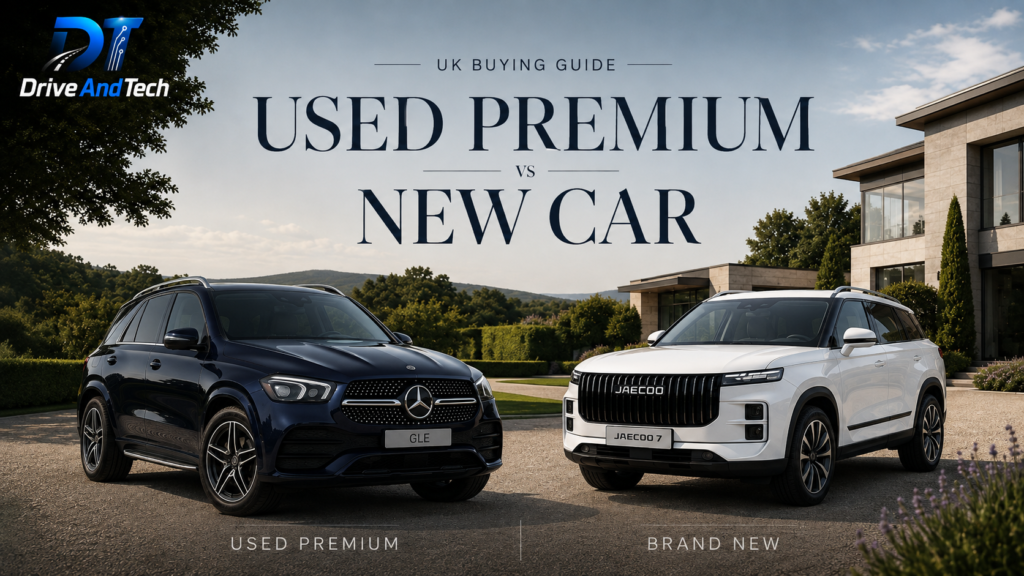
A £25,000 car budget can create a surprisingly difficult choice.
You could buy a recent Mercedes-Benz, BMW, Audi or Toyota with an established reputation and desirable badge. Alternatively, the same money may purchase a brand-new or nearly-new car with lower mileage, a longer manufacturer warranty, and newer technology.
This is where the used luxury car vs new car debate becomes more complicated than simply choosing between prestige and practicality.
A used premium car can offer genuine advantages. It may provide better cabin materials, stronger motorway refinement, more engaging handling and more predictable resale demand. Because the first owner has already absorbed much of the initial depreciation, it may also appear to offer significantly more car for the money.
However, the badge can sometimes distract buyers from what they are actually purchasing.
A three-year-old premium car may already have:
- Considerable mileage
- Limited manufacturer warranty
- Worn tyres or brakes
- Upcoming servicing requirements
- Expensive components that could fail outside warranty
Meanwhile, a less familiar brand may offer a new or nearly new alternative with zero or very low mileage, modern safety equipment, and several years of manufacturer protection for a similar price.
That does not automatically make the newer car the better purchase.
Some newer brands have less established dealer coverage, weaker resale evidence and more uncertain long-term reliability. A long warranty may provide reassurance, but it cannot prevent depreciation, insurance increases, parts delays or an ownership experience that does not meet the buyer’s expectations.
The real question is therefore not:
Should you buy the premium badge or avoid it?
It is:
Which vehicle gives you the strongest combination of quality, protection, running costs and future value for the money you are spending?
In this guide, DriveAndTech compares genuine UK price-overlap examples, including:
- A used Mercedes-Benz A-Class against a brand-new BYD Dolphin
- A used Mercedes-Benz GLA against a brand-new JAECOO 7
- A used Toyota RAV4 Hybrid against a brand-new Dacia Bigster Hybrid
- A used Mercedes-Benz C-Class or BMW 3 Series against a nearly-new BYD Seal
- A used BMW 3 Series Touring or Audi A4 Avant against a nearly-new BYD Seal 6 Touring
We will examine what each option gives you, what it may cost to own and when paying for the familiar badge is justified.
The aim is not to argue that every used premium car is poor value or that every new alternative is a bargain.
It is to help you avoid paying for reputation alone when another vehicle may offer more of what you actually need.
Affiliate Disclosure
DriveAndTech may earn a commission when you purchase through links on this page, at no additional cost to you. This does not influence our editorial opinions, ratings or recommendations.
Quick Answer
For most buyers comparing a used luxury car vs new car in the same £18,000–£30,000 budget, the best answer depends on what matters most.
Choose the used premium car when you value:
- Better cabin quality
- Stronger motorway refinement
- More engaging handling
- Greater badge appeal
- More established resale demand
- A wider network of experienced specialists
Choose the brand-new or nearly-new alternative when you value:
- Lower mileage
- More manufacturer warranty
- A known ownership history
- Newer safety and infotainment technology
- Fewer immediate maintenance concerns
- More predictable early ownership costs
For many risk-conscious buyers, a nearly-new car offers the strongest balance. It may already be discounted substantially from its original new price while retaining most of its manufacturer warranty.
However, a well-maintained used Mercedes-Benz, BMW, Audi or Toyota can still be the better purchase when it is clearly cheaper, has a complete service history and delivers meaningful advantages in comfort, driving quality or resale confidence.
The used-car badge trap begins when a buyer pays more for a familiar name without checking whether the specific vehicle justifies its:
- Higher mileage
- Shorter warranty
- Greater repair exposure
- Potentially higher running costs
The smartest decision is not automatically the newest car or the most prestigious badge.
It is the vehicle that offers the best total ownership proposition for the way you actually drive.
Why You Can Trust This Guide
DriveAndTech compares cars as ownership decisions, not just products.
For this guide, we focused on genuine UK price-overlap examples rather than comparing the cheapest possible used premium car with the most expensive version of a new alternative.
Each vehicle is assessed on what it offers for the money being spent, including:
- Current UK asking price
- Vehicle age and mileage
- Remaining manufacturer warranty
- Equipment and condition
- Powertrain suitability
- Insurance and servicing exposure
- Running costs and repair risk
- Depreciation and resale confidence
- Dealer and specialist support
- Suitability for everyday use
We also distinguish between brand-new, pre-registered, nearly-new, manufacturer-approved used, ordinary dealer-used and private-sale vehicles, because the purchase route can significantly affect warranty protection, preparation and ownership risk.
Our approach is deliberately balanced.
We do not assume that every premium car is worth paying more for, that every new car offers better value, or that a longer warranty automatically means lower total ownership cost.
A used premium car may still be the better choice when its comfort, driving quality, condition, support network and resale strength justify the additional risk.
A new or nearly-new alternative may offer stronger value when lower mileage, longer warranty, newer technology and more predictable early ownership matter more than the badge.
DriveAndTech does not rank a vehicle higher simply because it is newer, cheaper or more prestigious.
The recommendation depends on the complete ownership proposition and which option gives the buyer the strongest balance of quality, protection, running costs and future value.
Used Premium Car vs Brand-New Car at a Glance
| Comparison area | Used premium car | Brand-new or nearly-new alternative |
|---|---|---|
| Purchase price | Often gives access to a higher original list-price vehicle | May cost the same or slightly more in a genuine overlap zone |
| Mileage | Usually higher | Usually very low or delivery mileage |
| Warranty | Often limited or close to expiry | Usually longer manufacturer cover |
| Interior quality | Often stronger materials and refinement | Often more equipment, but not always the same premium feel |
| Driving experience | Frequently more polished or engaging | Often comfortable, modern and easier to live with |
| Technology | Depends heavily on trim and optional equipment | Usually newer and more widely standardised |
| Maintenance risk | Higher because of age, mileage and existing wear | Lower during the early years, but not zero |
| Depreciation | Much of the early loss may already have occurred | Can lose value faster, especially when bought brand new |
| Resale confidence | Usually stronger for established premium brands | May be less predictable for newer or less familiar brands |
| Dealer and specialist support | Often broader and more mature | Varies significantly by manufacturer |
| Best for | Buyers who prioritise refinement, prestige and driving quality | Buyers who prioritise warranty, low mileage and ownership certainty |
The Quickest Way to Decide
The used premium car is usually the stronger choice when:
- It is clearly cheaper
- Its service history is complete
- Its condition is excellent
- The buyer values refinement and driving quality
- The buyer has a realistic repair reserve
- Resale confidence matters
The brand-new or nearly-new alternative is usually the stronger choice when:
- The price difference is small
- Most of the manufacturer warranty remains
- Mileage is very low
- The buyer wants predictable early ownership costs
- Modern safety technology matters
- The buyer cannot comfortably absorb a large repair
The strongest middle ground is often a nearly new car that has already absorbed part of its initial depreciation while retaining most of its original warranty.
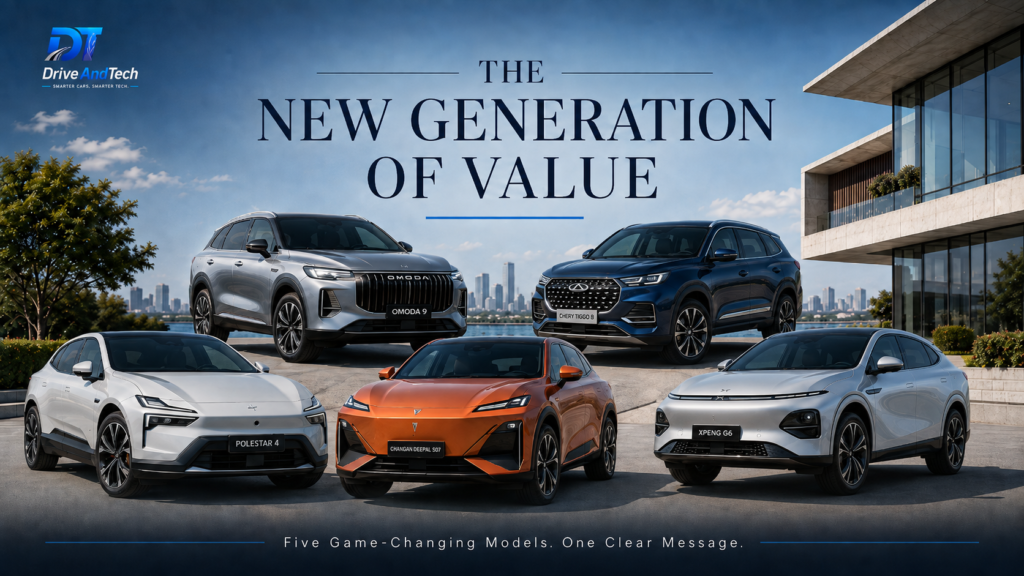
What Is the Used-Car Badge Trap?
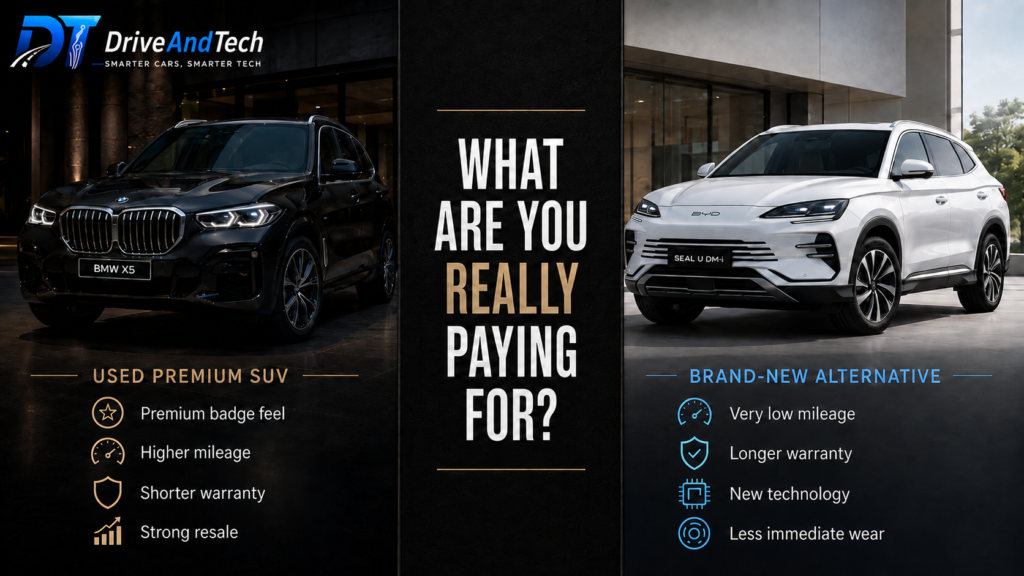
The used-car badge trap happens when a buyer focuses so heavily on the manufacturer’s name that they overlook the condition, warranty, running costs and alternatives available for the same money.
It does not mean that buying a Mercedes-Benz, BMW, Audi, Lexus or another premium model is automatically a mistake.
Premium cars can offer real advantages, including:
- Better cabin materials
- Stronger sound insulation
- More supportive seats
- More sophisticated suspension
- Better motorway refinement
- More engaging handling
- Greater badge recognition
- More established resale demand
The trap begins when those advantages are assumed rather than verified.
A premium badge cannot guarantee:
- Complete servicing
- Low repair costs
- Strong reliability
- Affordable insurance
- Good previous ownership
- Healthy tyres and brakes
- Remaining manufacturer warranty
- Accident-free history
The buyer may be purchasing the reputation of the model rather than the condition of the actual vehicle.
Why Familiar Badges Feel Safer
Established manufacturers benefit from decades of visibility, advertising and owner familiarity.
Buyers may already recognise:
- The badge
- The model name
- The dealer network
- The resale market
- The typical interior design
- The brand’s reputation
This familiarity can make a used premium car feel safer than a new vehicle from a newer or less familiar manufacturer.
In some respects, that confidence is justified.
Established brands often have:
- More dealers
- More independent specialists
- Better-known fault patterns
- Wider parts availability
- Larger used-car markets
- More predictable part-exchange values
However, familiarity should not be confused with low ownership risk.
A well-known premium model may still contain:
- Complex automatic transmissions
- Expensive electronic systems
- Advanced suspension
- Diesel emissions equipment
- Plug-in hybrid components
- Large wheels and costly tyres
The badge may make the vehicle easier to understand and resell, but it does not make age, mileage or wear disappear.
Why the Newer Alternative Can Be Overlooked
A newer alternative may not create the same immediate emotional response.
It may have:
- A less prestigious badge
- A smaller UK dealer network
- Limited long-term reliability evidence
- Less predictable resale value
- Lower perceived interior quality
These weaknesses are important and should not be ignored.
But the same car may also offer:
- Delivery or very low mileage
- Several years of manufacturer warranty
- Newer safety systems
- More standard equipment
- No previous private owner
- Lower immediate maintenance risk
- A significant discount from its original price
The mistake is not choosing the premium vehicle.
The mistake is dismissing the newer alternative before comparing what each car actually provides.
Premium Quality vs Equipment Quantity
Used premium cars and newer alternatives often deliver value in different ways.
The premium car may provide:
- Better seat comfort
- More refined suspension
- Higher-quality materials
- Quieter motorway driving
- More natural controls
- Stronger driving dynamics
The newer alternative may provide:
- Larger infotainment screens
- Surround-view cameras
- Wireless smartphone connectivity
- More driver-assistance systems
- Heated or ventilated seats
- Longer warranty
- Lower mileage
A longer equipment list does not automatically create a better car.
Likewise, softer dashboard materials do not automatically justify higher repair exposure.
The buyer must decide which qualities will matter most during everyday ownership.
The Price-Overlap Test
The badge trap is most visible when the used premium car and newer alternative occupy the same realistic budget.
A proper comparison should use:
- Similar transaction prices
- Representative mileage
- Comparable body styles
- Appropriate trim levels
- Realistic finance terms
- The same intended ownership period
It is misleading to compare the cheapest high-mileage premium example with the most expensive new alternative.
It is equally misleading to compare a heavily discounted nearly-new car with an unusually expensive approved-used premium model and present the result as universal.
The comparison must reflect what a normal UK buyer can realistically purchase at the same time and within the same budget.
The Ownership-Risk Test
Before choosing the used premium car, ask:
What additional ownership risk am I accepting for the badge?
That risk may include:
- Less warranty
- More mileage
- Earlier servicing requirements
- Existing tyre and brake wear
- Higher labour rates
- More expensive replacement parts
- Greater repair complexity
Then ask:
What genuine benefits am I receiving in return?
Those benefits may include:
- Better refinement
- Greater comfort
- Stronger driving quality
- Established resale demand
- Better specialist support
- More confidence in long-term ownership
When the benefits clearly outweigh the additional risk, the premium car may be the better purchase.
When they do not, the buyer may simply be paying for familiarity.
The New-Car Trap Also Exists
There is an opposite mistake: assuming that a new car is automatically better value because it has lower mileage and a longer warranty.
A newer vehicle may still suffer from:
- Heavy depreciation
- Weak resale demand
- Expensive insurance
- Limited dealer coverage
- Slow parts supply
- Poor motorway refinement
- Unproven long-term reliability
- A finance agreement with a large final payment
Warranty protects against certain faults.
It does not protect the buyer against:
- Depreciation
- Insurance increases
- Inconvenient dealer support
- Dissatisfaction with the car
- Paying too much through finance
The decision should therefore remain balanced.
DriveAndTech View
The badge should be treated as one part of the vehicle’s value—not as proof that the car is the best purchase.
A used premium car earns its price when it delivers meaningful advantages in:
- Comfort
- Refinement
- Driving experience
- Condition
- Support
- Resale confidence
A new or nearly-new alternative earns its price when it delivers meaningful advantages in:
- Mileage
- Warranty
- Technology
- Maintenance certainty
- Everyday suitability
The best buyer does not reject the badge or chase it automatically.
They compare what the badge gives them against what it asks them to accept.
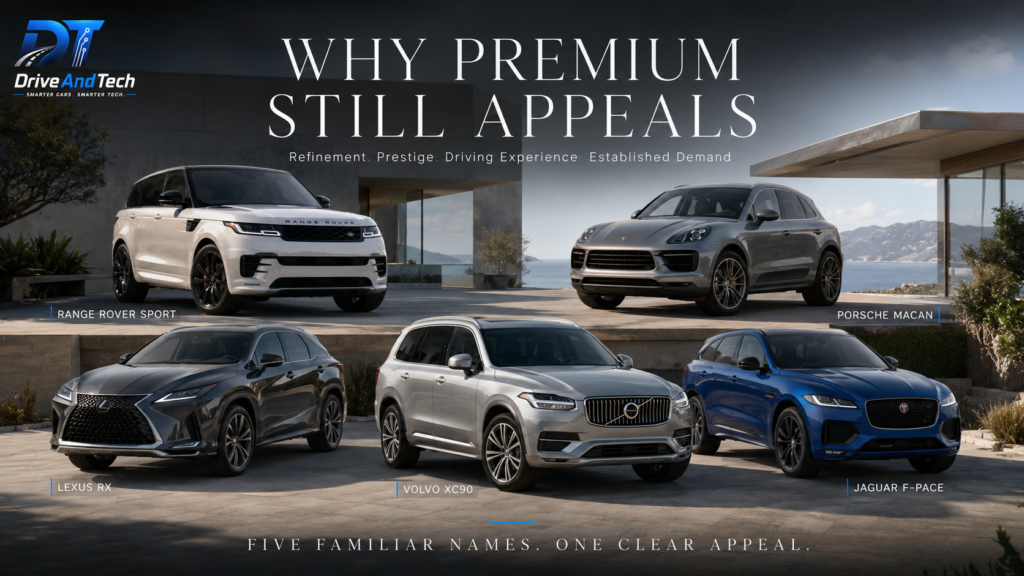
How We Compared the Cars
To keep this guide useful, each comparison uses a genuine UK price-overlap zone rather than broad list-price ranges.
The aim is to answer a practical question:
What can a UK buyer realistically choose between when spending roughly the same amount of money?
Each vehicle pair is assessed across the following areas:
- Current UK asking price
- Vehicle age
- Mileage
- Remaining warranty
- Powertrain suitability
- Interior quality
- Practicality
- Running costs
- Repair exposure
- Depreciation
- Resale confidence
- Dealer and specialist support
We Compare Like-for-Like Budgets
The comparisons do not use:
- The cheapest high-mileage premium example
- The most expensive version of the newer alternative
- Unusually discounted damaged vehicles
- Rare or unrepresentative listings
- Finance offers with incompatible deposits or mileage limits
Instead, the guide focuses on representative cars that normal buyers are likely to encounter within the same realistic budget.
We Distinguish New From Nearly New
A brand-new vehicle and a nearly-new vehicle are not the same.
A nearly-new car may already have:
- One registered keeper
- Several thousand miles
- A warranty that began before the current buyer
- Previous use as a demonstrator, fleet car or management vehicle
- Significant depreciation from its original list price
This can make it excellent value, but it must not be presented as an unregistered new car.
We Consider the Purchase Route
The same model can present a very different level of risk depending on where it is purchased.
We distinguish between:
- Private sale
- Independent dealer
- Manufacturer-approved used
- Pre-registered stock
- Ex-demonstrator
- Nearly-new dealer stock
- Brand-new retail purchase
The purchase route affects:
- Legal protection
- Warranty
- Vehicle preparation
- Complaint handling
- Inspection risk
- Price
We Compare Ownership, Not Just Equipment
A larger screen or longer equipment list does not automatically make a car better value.
Likewise, a premium badge does not automatically justify more mileage or less warranty.
Each comparison considers what the buyer is likely to experience after purchase, including:
- Servicing
- Insurance
- Tyres
- Brakes
- Fuel or charging
- Repair risk
- Depreciation
- Dealer support
- Future resale
We Match the Powertrain to the Buyer
A car can appear efficient on paper but be poorly suited to the owner’s driving pattern.
For example:
- A diesel may suit regular motorway mileage
- A self-charging hybrid may suit mixed and urban use
- A plug-in hybrid may only deliver its strongest benefit when charged regularly
- An electric vehicle may be most attractive with dependable home or workplace charging
The recommendation therefore considers how the powertrain is likely to be used, not just its official figures.
DriveAndTech Comparison Principle
The better-value vehicle is not simply the cheapest, newest or most prestigious.
It is the car that offers the strongest balance of:
- Quality
- Protection
- Running costs
- Suitability
- Future value
for the buyer’s actual needs.
Used Mercedes-Benz A-Class vs Brand-New BYD Dolphin
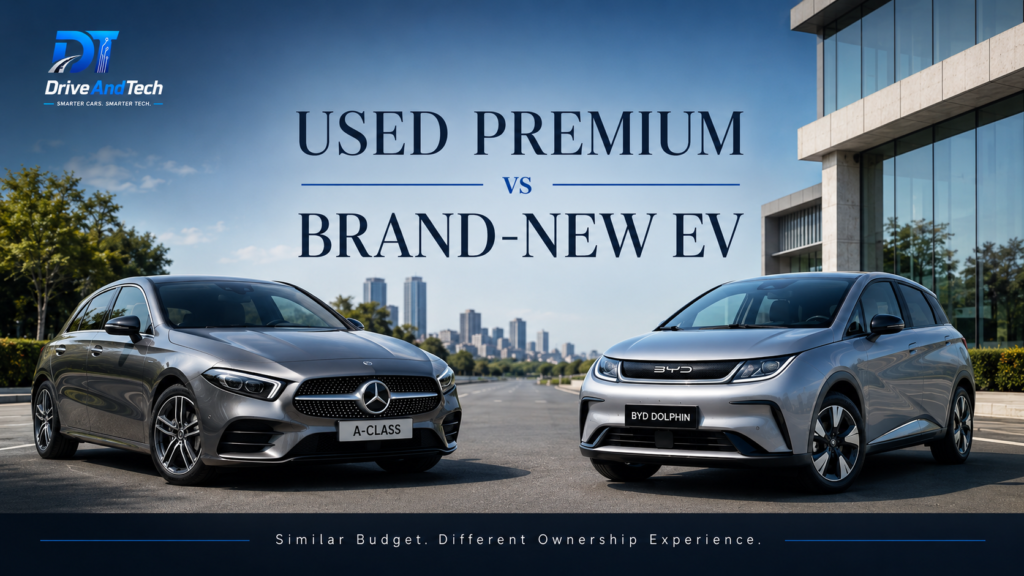
Comparison type: Similar-size alternative
Genuine price-overlap zone: Approximately £25,000–£30,000
Powertrain difference: Petrol mild hybrid vs fully electric
Best suited to: Buyers choosing between premium familiarity and new-car warranty protection
A recent Mercedes-Benz A-Class and a brand-new BYD Dolphin now compete closely enough on price to create a genuine buying decision, even though they offer very different ownership experiences. The A-Class brings premium-brand recognition, an established UK support network and conventional petrol convenience. The Dolphin gives up some prestige in exchange for zero previous-owner mileage, stronger warranty protection and a fully electric drivetrain.
The central question is simple:
Do you spend slightly less on a used premium hatchback, or stretch a little further for a completely new EV with substantially more warranty remaining?
DriveAndTech Market Price Guide (UK)
| Vehicle | Representative buying position | Likely price guide |
|---|---|---|
| Used Mercedes-Benz A-Class | 2024 A180/A200 AMG Line Premium or Premium Plus | £25,000–£27,000 |
| BYD Dolphin Comfort | Brand new | £30,230 list |
| Discounted BYD Dolphin Comfort | Participating-retailer offer | Around £28,519 |
| BYD Dolphin Design | Brand new, higher specification | £31,730 list |
| Discounted BYD Dolphin Design | Participating-retailer offer | Around £29,974 |
The fairest comparison is therefore a well-equipped 2024 Mercedes-Benz A-Class at around £25,000–£27,000 versus a discounted brand-new BYD Dolphin at around £28,500–£30,000.
The BYD usually costs roughly £2,000–£4,000 more, so this should not be presented as an exact same-price comparison.
What the Mercedes-Benz A-Class Gives You
The A-Class provides something the BYD cannot fully reproduce: a recognised premium ownership experience.
Its key strengths include:
- Stronger badge appeal
- Higher perceived cabin quality
- Established Mercedes-Benz dealer and specialist support
- Familiar petrol refuelling
- Easier long-distance use without charging planning
- More mature used-market demand
- Potentially easier resale
- Wider choice of used trims and specifications
The current A180 also remains modern enough that buying used does not mean accepting an outdated cabin or infotainment system.
For buyers who make frequent long journeys, cannot charge at home or simply prefer conventional refuelling, the Mercedes can still be the more convenient car.
What the Brand-New BYD Dolphin Gives You
The Dolphin’s strongest argument is not luxury. It is the amount of new-car ownership protection and technology available for a relatively modest additional outlay.
The Dolphin Comfort includes:
- 60.4kWh battery
- Up to 265 miles WLTP combined range
- 204PS
- 0–62mph in around seven seconds
- 12.8-inch infotainment touchscreen
- Apple CarPlay and Android Auto
- 360-degree camera
- Flat rear floor
- 345-litre boot
Higher trims add features such as a panoramic glass roof, wireless charging and heated and ventilated front seats.
That makes the Dolphin a credible alternative rather than simply a cheaper-brand substitute.
Warranty: A Major BYD Advantage
Warranty protection strongly favours the new BYD.
BYD’s UK warranty package generally includes:
- 6 years/93,750 miles basic vehicle cover
- 8 years/93,750 miles drive-unit cover
- 8 years/125,000 miles battery cover
The warranty remains subject to servicing requirements, exclusions and model-specific conditions.
A 2024 Mercedes may still have part of its original three-year warranty remaining, but that protection is likely to expire substantially sooner.
For buyers planning to keep the car for several years, this difference can materially reduce ownership risk.
Running Costs and Charging
The Dolphin is likely to be cheaper to power when most charging is completed at home on a suitable tariff.
It will usually suit buyers who:
- Have dependable home or workplace charging
- Drive mainly in towns and surrounding areas
- Can complete most journeys within its usable range
- Want to reduce routine energy costs
- Plan to keep the car long enough to benefit from the warranty
The A-Class may suit buyers who:
- Regularly cover long distances
- Have no driveway
- Cannot install a home charger
- Prefer rapid petrol refuelling
- Do not want to plan around charging infrastructure
The BYD’s running-cost advantage can narrow considerably if the owner relies heavily on expensive public rapid charging.
Insurance should also be quoted individually. A new EV is not automatically cheaper to insure than a used premium petrol car.
Interior Quality and Technology
The Mercedes remains the stronger choice for traditional premium presentation.
Its cabin is likely to feel more sophisticated in material quality, design cohesion and overall brand experience.
The Dolphin counters with newer technology, a large rotating touchscreen, connected features, over-the-air updates and a strong standard equipment list.
The distinction is therefore clear:
The Mercedes may feel more premium. The BYD may feel more technologically generous for the money.
A test drive matters here. A larger screen does not automatically create a better cabin.
Depreciation and Resale
This is the strongest financial argument for the Mercedes.
The A-Class has already passed through part of its initial depreciation and benefits from a large, established used-car market.
The brand-new Dolphin begins depreciating from its new price, while BYD’s longer-term UK residual values remain less predictable.
However, the Dolphin’s transferable warranty may help future demand.
The trade-off is straightforward:
The BYD reduces repair uncertainty.
The Mercedes reduces some early depreciation exposure and offers more established resale behaviour.
What Could You Regret?
Choose the Mercedes and you may regret: paying for badge prestige while accepting previous-owner mileage, losing warranty relatively soon or facing higher specialist repair costs later.
Choose the BYD and you may regret: paying £2,000–£4,000 more, relying on public charging, facing less predictable resale values or missing the Mercedes’ more premium cabin and badge appeal.
DriveAndTech Better-Value Choice
Brand-New BYD Dolphin Comfort
For buyers with reliable charging who intend to keep the car for several years, the Dolphin offers the stronger combination of warranty, low mileage, electric performance and ownership certainty.
The additional upfront cost can be justified by receiving a completely unused vehicle with substantially more manufacturer protection.
DriveAndTech Premium Experience Choice
Used Mercedes-Benz A-Class AMG Line Premium or Premium Plus
Choose the Mercedes if premium cabin quality, brand familiarity, easier long-distance use and established resale demand matter more than having the newest car.
Buyer Confidence
Mercedes-Benz A-Class: High
Best with a complete service history, sensible mileage, useful warranty remaining and a professional inspection.
BYD Dolphin: Medium to High
New condition and long warranty support confidence, although charging suitability, dealer coverage and future resale remain less established.
DriveAndTech Verdict
The brand-new BYD Dolphin does not make the used Mercedes-Benz A-Class irrelevant.
The Mercedes remains more prestigious, more familiar and potentially easier to resell. It is also likely to be the more convenient choice for buyers who regularly drive long distances without dependable charging.
But when a well-equipped 2024 A-Class reaches £26,000–£27,000, a discounted Dolphin at roughly £28,500–£30,000 deserves serious consideration.
For a relatively modest additional outlay, the BYD offers zero previous-owner mileage, stronger performance, modern technology and several extra years of manufacturer protection.
Choose the A-Class for premium familiarity, petrol convenience and established ownership confidence.
Choose the Dolphin for warranty, electric technology and new-car certainty.
Neither is universally better.
But choosing the Mercedes automatically because of the badge or choosing the BYD automatically because it is new would ignore the real trade-offs that matter most.
[Compare new and pre-registered electric-car offers]
Suggested CTA: Compare current cash prices and total finance costs before choosing between a used premium hatchback and a brand-new electric car.
[Compare home EV charger installation quotes]
Suggested CTA: Check the cost of installing a home charger before deciding whether an electric car will genuinely reduce your running costs.
Used Mercedes-Benz GLA vs Brand-New JAECOO 7
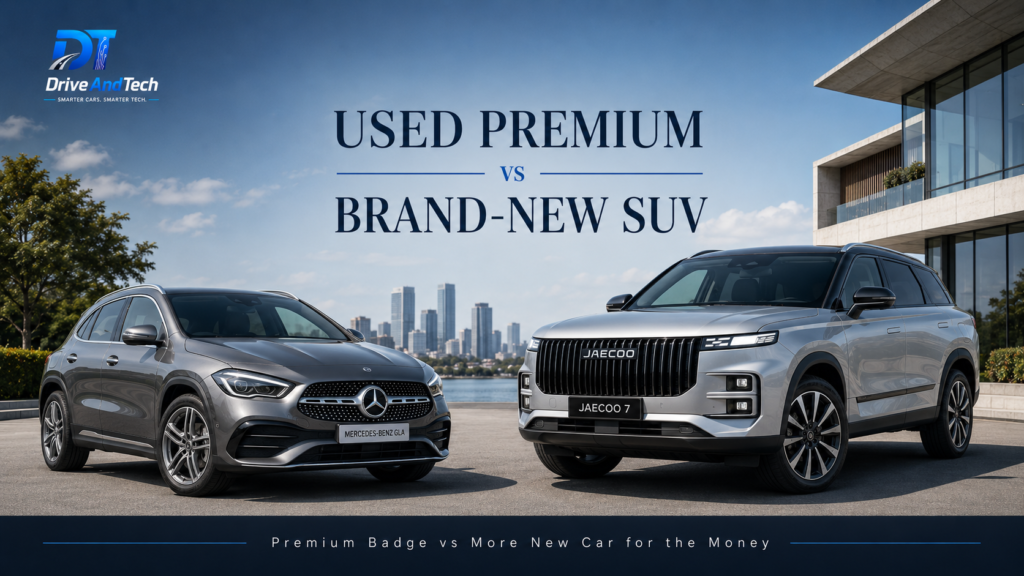
Comparison type: Similar-budget SUV alternative
Genuine price-overlap zone: Approximately £29,000–£31,000
Powertrain comparison: Mercedes mild-hybrid petrol vs JAECOO self-charging hybrid or petrol
Best suited to: Buyers choosing between established premium status and a larger new SUV with long warranty protection
The Mercedes-Benz GLA and JAECOO 7 are not direct class rivals.
The GLA is a compact premium SUV, while the JAECOO 7 is a larger, value-focused family SUV. But their prices now overlap closely enough to create a genuine used premium car vs brand-new alternative decision.
A recent GLA offers stronger badge recognition, established UK support and more predictable resale behaviour. The JAECOO offers more space, zero previous-owner mileage and substantially longer manufacturer warranty protection.
DriveAndTech Market Price Guide (UK)
| Vehicle | Representative buying position | Likely price guide |
|---|---|---|
| Mercedes-Benz GLA 200h AMG Line Executive | 2024, modest mileage | £27,000–£29,000 |
| Mercedes-Benz GLA 200h AMG Line Premium | 2024, higher specification | £29,000–£31,000 |
| JAECOO 7 SHS-H Pure Hybrid | Brand new | £29,210 |
| JAECOO 7 Petrol Deluxe | Brand new | £30,165 |
| JAECOO 7 SHS-H Deluxe Hybrid | Higher-spec new model | £32,810 |
The fairest comparison is therefore a well-equipped 2024 Mercedes-Benz GLA at roughly £29,000–£31,000 versus a brand-new JAECOO 7 at around £29,210–£30,165.
In some cases, the new JAECOO can cost no more than the used Mercedes.
What the Mercedes-Benz GLA Gives You
The GLA’s strongest advantage is not size or warranty. It is the confidence that comes with an established premium product.
Its key strengths include:
- Strong Mercedes-Benz badge recognition
- More established resale demand
- Mature dealer and independent-specialist support
- Familiar servicing and parts availability
- Premium cabin presentation
- Compact dimensions that suit urban driving
- A much longer UK ownership history
The GLA therefore appeals to buyers who value refinement, brand familiarity and a more predictable ownership ecosystem.
It may also suit drivers who simply do not need the JAECOO’s larger dimensions.
What the Brand-New JAECOO 7 Gives You
The JAECOO’s value argument is much simpler:
For roughly the same money as a recent used GLA, you can buy a larger SUV that has never had a previous owner and carries a long manufacturer warranty.
The JAECOO 7 offers:
- Brand-new condition
- No previous-owner wear
- Up to 7 years/100,000 miles vehicle warranty
- Up to 8 years/100,000 miles high-voltage battery warranty where applicable
- More family-SUV presence and interior space
- Generous standard technology
- Petrol, self-charging hybrid and plug-in hybrid choices
The SHS-H hybrid is particularly relevant because it does not require plugging in. That gives buyers hybrid assistance without needing a driveway or home charger.
For families planning to keep the car for several years, the warranty difference alone is significant.
Size, Interior and Equipment
The JAECOO gives you noticeably more physical vehicle for the money.
The Mercedes GLA is a compact SUV, while the JAECOO 7 is positioned as a mid-sized family SUV. That should translate into a stronger sense of space and road presence, although the larger dimensions may make the JAECOO less convenient in tight urban environments.
The interior comparison is less straightforward.
The GLA is likely to feel more premium, with a more established approach to cabin materials, fit and finish and overall design cohesion.
The JAECOO offers more visible equipment, particularly in higher trims, with features such as:
- Large central touchscreen
- Wireless smartphone integration
- Heated and ventilated front seats
- Heated rear seats
- Head-up display
- Surround-view camera
- Panoramic roof
- Electric tailgate
This creates an important distinction:
The Mercedes may feel more expensive. The JAECOO may give you more equipment for the money.
Buyers should therefore sit in both rather than judging cabin quality from specification sheets alone.
Warranty and Ownership Confidence
Mercedes-Benz new-car warranty protection is much shorter than JAECOO’s. A 2024 GLA may retain some manufacturer cover, depending on its registration date, but that protection is likely to expire considerably sooner.
The JAECOO begins with up to seven years of vehicle cover.
That can reduce short- to medium-term repair exposure, but warranty length should not be treated as unlimited protection. Buyers should still confirm servicing requirements, mileage limits, exclusions, local dealer support and how quickly parts can be supplied.
The Mercedes has the advantage of a much more mature UK ownership infrastructure.
The JAECOO has the advantage of significantly more warranty remaining.
Running Costs
The JAECOO SHS-H hybrid may offer a fuel-economy advantage in urban and mixed driving compared with the Mercedes mild-hybrid petrol.
It may also provide more predictable short-term costs because the vehicle is new and protected by a long warranty.
The Mercedes counters with:
- Greater independent-garage familiarity
- Well-established servicing competition
- Better-understood maintenance requirements
- Stronger parts availability
Insurance should be checked individually. A less prestigious badge does not automatically mean lower premiums.
Depreciation and Resale
This is where the Mercedes makes its strongest financial counterargument.
The GLA has already absorbed some of its first-owner depreciation and benefits from:
- Strong used-market recognition
- A large buyer pool
- Familiar part-exchange values
- More predictable residual-value behaviour
The JAECOO begins its depreciation from new.
Its rapidly growing UK presence is encouraging, but there is still much less evidence showing how older JAECOO models will perform in the used market several years from now.
The long warranty may help future demand, but it cannot guarantee resale values.
The financial trade-off is therefore clear:
The Mercedes brings greater repair exposure but more established residual values.
The JAECOO brings stronger warranty protection but greater long-term depreciation uncertainty.
What Could You Regret?
Choose the Mercedes and you may regret: paying new-car money for a used SUV, receiving less warranty, inheriting existing tyre or brake wear, or facing higher premium-brand repair costs later.
Choose the JAECOO and you may regret: heavier early depreciation, less predictable resale values, slower parts support, or discovering that you preferred the Mercedes’ cabin quality and compact dimensions.
DriveAndTech Better-Value Choice
Brand-New JAECOO 7 SHS-H Pure Hybrid
At around £29,210, the JAECOO offers a brand-new, larger hybrid SUV with long warranty protection for roughly the same money as a well-equipped 2024 GLA.
For a family buyer who values space, equipment and several years of ownership certainty, the value case is exceptionally strong.
DriveAndTech Premium Experience Choice
Used Mercedes-Benz GLA 200h AMG Line Premium
Choose the GLA if premium feel, compact dimensions, established support and more predictable resale demand matter more than outright space and warranty length.
Buyer Confidence
Mercedes-Benz GLA: High
Best with complete servicing, sensible mileage and useful manufacturer warranty remaining.
JAECOO 7: Medium to High
The new-car warranty and growing UK presence support confidence, although long-term reliability and resale evidence remain less established.
DriveAndTech Verdict
This comparison works because the price overlap is genuine.
A well-equipped 2024 Mercedes-Benz GLA can cost approximately £29,000–£31,000, while a brand-new JAECOO 7 can sit in almost exactly the same price range.
The Mercedes gives you premium familiarity, a stronger badge, compact dimensions and established resale confidence.
The JAECOO gives you more space, no previous-owner mileage, more warranty and potentially stronger hybrid efficiency.
For buyers prioritising value, family practicality and long-term warranty protection, the JAECOO 7 is the DriveAndTech better-value choice.
For buyers who genuinely prefer the Mercedes’ refinement, size, support network and resale profile, the GLA remains entirely reasonable.
Choosing the Mercedes purely for the badge would be difficult to justify.
Choosing it because its ownership experience better matches your priorities would not be.
[ Compare new and pre-registered SUV offers]
Suggested CTA: Compare current cash prices, warranty terms and total finance costs before paying used premium-SUV money.
[Compare car insurance quotes]
Suggested CTA: Check insurance costs for both vehicles before assuming that the newer or less prestigious SUV will be cheaper to run.
Used Toyota RAV4 Hybrid vs Brand-New Dacia Bigster Hybrid
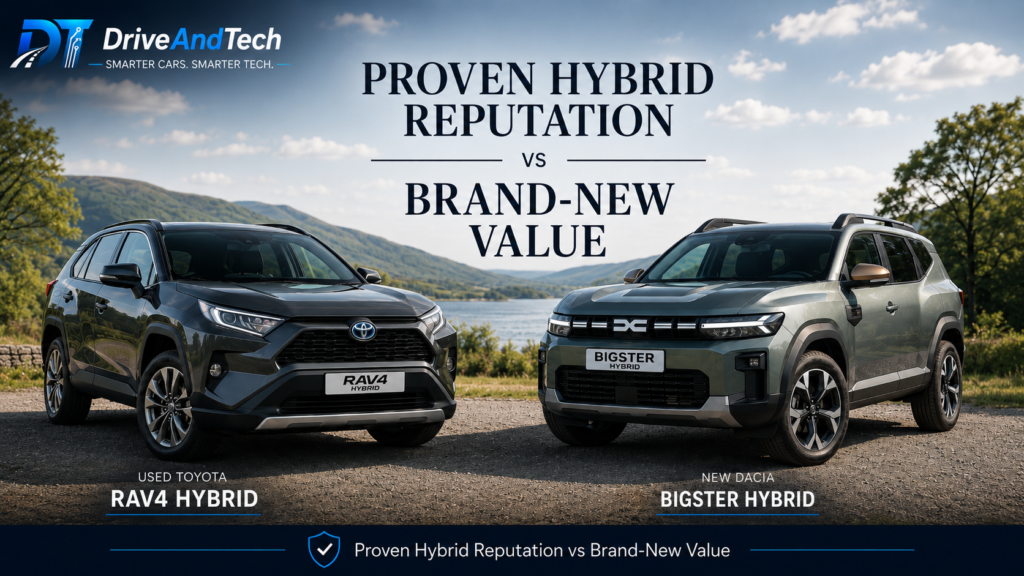
Comparison type: Direct family-SUV budget alternative
Genuine price-overlap zone: Approximately £27,000–£31,000
Powertrain comparison: Toyota 2.5-litre full hybrid vs Dacia 1.8-litre full hybrid
Best suited to: Families choosing between proven Toyota ownership confidence and a completely new SUV at a lower starting price
The Toyota RAV4 Hybrid and Dacia Bigster Hybrid create one of the most balanced comparisons in this guide.
Both are automatic full-hybrid family SUVs, and neither requires home charging. More importantly, a recent RAV4 Hybrid can cost almost exactly the same as a brand-new, well-equipped Bigster Hybrid.
The decision is therefore straightforward:
Do you choose a used Toyota with proven hybrid engineering, established resale demand and potentially extensive service-activated warranty cover or a brand-new Dacia with zero previous-owner mileage and a lower purchase price?
DriveAndTech Market Price Guide (UK)
| Vehicle | Representative buying position | Likely price guide |
|---|---|---|
| Used Toyota RAV4 Hybrid Design | 2024 model, representative mileage | £29,000–£31,000 |
| Dacia Bigster Expression Hybrid 155 | Brand new | £26,715 |
| Dacia Bigster Journey Hybrid 155 | Brand new, higher specification | £28,265 |
The fairest comparison is therefore a 2024 Toyota RAV4 Hybrid Design at around £29,000–£31,000 versus a brand-new Dacia Bigster Journey Hybrid at £28,265.
Unlike some other used-versus-new comparisons, the brand-new alternative can actually cost less.
What the Toyota RAV4 Gives You
The RAV4’s premium is not primarily about prestige.
Buyers are paying for:
- Toyota’s long-established hybrid experience
- Strong reliability confidence
- Proven resale demand
- Familiar dealer and independent-garage support
- A well-understood long-term ownership record
- Potential access to Toyota’s service-activated warranty
The RAV4 has also been on the market long enough for buyers, dealers and insurers to understand its strengths, typical faults and used values.
That makes the Toyota badge valuable for a different reason from a luxury badge: trust, durability and predictability.
Toyota’s Warranty Advantage
This comparison becomes particularly interesting because the used Toyota may retain unusually strong warranty potential.
Every new Toyota begins with manufacturer warranty protection, while eligible vehicles can receive additional cover following qualifying servicing at a Toyota Approved dealer, subject to age, mileage and programme conditions.
For an eligible RAV4, this can extend manufacturer-backed protection significantly beyond the original warranty period.
That means buyers should not assume:
Used Toyota = little warranty.
New Dacia = up to 75,000 miles or 7 years’ warranty.
A correctly maintained RAV4 may continue to receive meaningful protection for years.
The important checks are the exact service history, mileage, warranty eligibility and whether future servicing requirements fit your ownership plans.
What the Brand-New Dacia Bigster Gives You
The Bigster makes a very different argument.
For less than many 2024 RAV4s, you receive:
- A completely new vehicle
- Zero previous-owner wear
- A known history from day one
- Full-hybrid automatic power
- Modern infotainment and equipment
- Strong family practicality
- New tyres, brakes and suspension components
- No need to investigate how somebody else treated the car
The Bigster Journey Hybrid is especially relevant because it offers enough equipment and practicality to avoid feeling like a stripped-back budget alternative.
This is not simply a case of better badge versus cheaper car.
It is a used, proven SUV competing with a genuinely credible new family SUV.
Space and Everyday Practicality
The Bigster has a strong practicality advantage, particularly for families carrying luggage, pushchairs or holiday equipment.
Its large boot and substantial cabin are central to its value proposition.
The RAV4 is also a spacious family SUV, so buyers should focus less on headline litre figures and more on how each car works in real life.
Check:
- Rear-seat space
- Child-seat access
- Boot floor shape
- Loading height
- Towing requirements
- Parking convenience
- Hybrid-battery intrusion
The Dacia may provide more space for the money, but the Toyota may still suit buyers who prefer a more familiar and proven package.
Reliability and Ownership Confidence
This is where the Toyota has the clearest advantage.
Toyota’s hybrid systems have been used across multiple generations and are widely understood by dealers, independent specialists and owners.
The Bigster is much newer, so its long-term reliability cannot yet be judged from many years of UK ownership data.
That does not mean the Dacia should be considered unreliable.
It simply means the evidence is different:
RAV4: proven long-term reliability confidence.
Bigster: minimal initial wear, but less long-term model history.
For buyers intending to keep the car well beyond the warranty period, that distinction matters.
Running Costs
Both vehicles use full-hybrid systems and can operate without external charging, making them suitable for drivers who:
- Do not have a driveway
- Mix urban and motorway driving
- Regularly make long journeys
- Want hybrid efficiency without EV charging
The Dacia’s lower purchase price creates an immediate financial advantage.
The Toyota may recover part of its higher purchase cost through stronger resale demand, established reliability and a mature servicing network.
Insurance should still be checked individually before purchase. A cheaper new car is not automatically cheaper to insure.
Depreciation and Resale
This is one of the RAV4’s strongest financial arguments.
A 2024 Toyota has already absorbed some of its first-owner depreciation. It also benefits from a strong reputation and a large pool of buyers who already understand the model.
The Bigster begins its depreciation from new.
Its value-led positioning may help future demand, but there is less evidence showing how Bigsters will perform at five, seven or eight years old.
This creates an important ownership trade-off:
The Dacia costs less today.
The Toyota may be easier to sell confidently later.
A buyer planning to change cars again in two or three years may value Toyota’s established residuals more strongly.
Someone keeping the vehicle for seven or eight years may place greater value on starting with zero mileage and controlling its entire maintenance history.
What Could You Regret?
Choose the RAV4 and you may regret: paying several thousand pounds more for a used vehicle, inheriting existing tyre or brake wear, or paying a Toyota reliability premium when the cheaper new car would have met your needs.
Choose the Bigster and you may regret: heavier early depreciation, less predictable resale values, limited long-term reliability evidence or discovering that Toyota’s proven hybrid reputation mattered more than you expected.
DriveAndTech Better-Value Choice
Brand-New Dacia Bigster Journey Hybrid 155
At around £28,265, the Bigster costs less than many 2024 RAV4 Hybrid Design examples while giving you a completely new vehicle, strong family practicality and full control of its history from day one.
For families intending to keep the car for several years, the value proposition is extremely strong.
DriveAndTech Ownership-Confidence Choice
Used Toyota RAV4 Hybrid Design
Choose the RAV4 if proven hybrid engineering, resale confidence, mature dealer support and Toyota’s warranty structure matter more than starting with a completely new car.
Unlike a traditional prestige comparison, paying extra for the Toyota can be justified by long-term ownership confidence rather than badge status alone.
Buyer Confidence
Toyota RAV4 Hybrid: High
Strongest with complete history, sensible mileage and confirmed eligibility for Toyota’s service-activated warranty programme.
Dacia Bigster Hybrid: Medium to High
New condition and strong practicality support confidence, although long-term reliability and resale evidence remain much less established.
DriveAndTech Verdict
This is one of the closest used-versus-new family SUV comparisons in the article.
A 2024 Toyota RAV4 Hybrid Design can cost approximately £29,000–£31,000.
A brand-new Dacia Bigster Journey Hybrid costs around £28,265, while the Expression Hybrid starts even lower.
The Bigster gives you a lower purchase price, zero previous-owner wear, modern equipment and strong family practicality.
The RAV4 gives you proven hybrid engineering, stronger resale confidence, an established support network and potentially extensive warranty protection through qualifying servicing.
For immediate value, the Dacia Bigster is the DriveAndTech winner.
For buyers prioritising proven reliability and long-term ownership confidence, the Toyota RAV4 remains the safer choice.
Paying more for the Toyota is therefore not necessarily paying for a badge.
But paying £30,000 for a used RAV4 without first comparing a completely new Bigster costing less would be difficult to justify.
[Compare new and pre-registered family-SUV offers]
Suggested CTA: Compare current cash prices and total finance costs before choosing between a recent used hybrid SUV and a brand-new alternative.
[Run a full used-car history check]
Suggested CTA: Check outstanding finance, mileage history, accident records and previous write-off status before paying nearly new-car money for a used RAV4.
Used Mercedes-Benz C-Class or BMW 3 Series vs Nearly-New BYD Seal
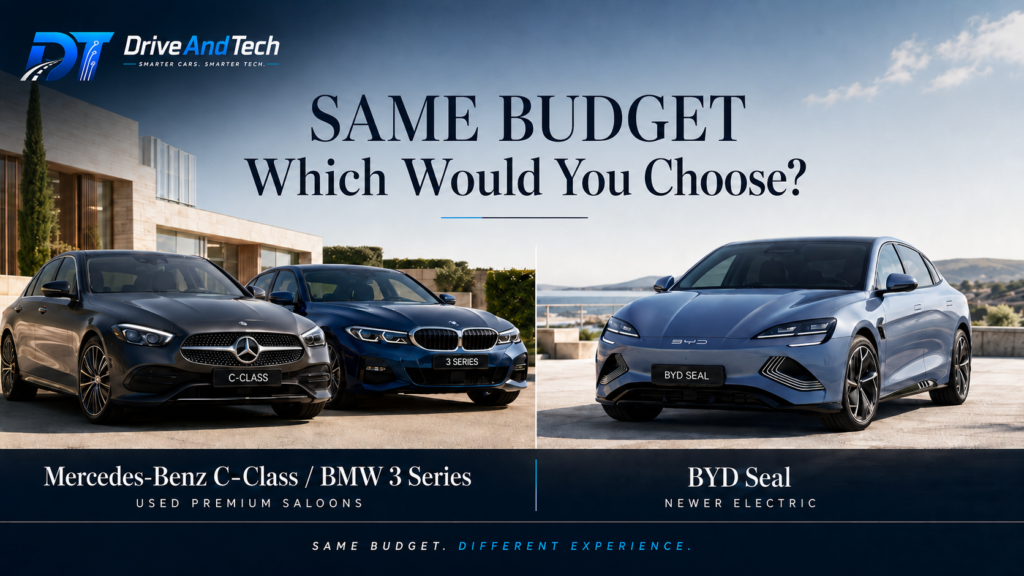
Comparison type: Direct executive-saloon alternative
Price-overlap zone: Approximately £25,000–£30,000
Powertrain comparison: Petrol, diesel or plug-in hybrid vs fully electric
Best suited to: Buyers choosing between established premium-car prestige and a newer electric saloon with substantial warranty remaining
The Mercedes-Benz C-Class, BMW 3 Series and BYD Seal now overlap closely enough on the used market to create a genuine same-price decision.
A recent C-Class or 3 Series offers familiar premium branding, established dealer support and conventional petrol, diesel or plug-in hybrid powertrains. A nearly-new BYD Seal offers much lower mileage, strong electric performance, generous standard equipment and considerably more manufacturer warranty remaining.
The choice is therefore not simply German prestige versus cheaper EV. At around £25,000–£28,000, these cars compete directly for the same buyer.
DriveAndTech Market Price Guide (UK)
| Vehicle | Representative example | Likely price guide |
|---|---|---|
| Mercedes-Benz C200 AMG Line | 2024 mild-hybrid petrol | £25,000–£27,000 |
| Mercedes-Benz C200 AMG Line Premium | 2024 higher-specification model | Around £29,500 |
| BMW 330e M Sport | 2023 plug-in hybrid | £22,000–£27,500 |
| Nearly-new BYD Seal Design | 2024, approximately 7,000–17,000 miles | £26,000–£27,000 |
| Higher-priced BYD Seal | Newer or lower-mileage stock | £28,000–£31,000 |
The closest comparison is therefore a 2024 Mercedes-Benz C200 AMG Line or 2023 BMW 330e M Sport at roughly £25,000–£28,000 versus a low-mileage 2024 BYD Seal Design at around £26,000–£27,000.
What the Mercedes-Benz C-Class Gives You
The C-Class delivers the strongest traditional luxury experience.
Its key strengths include:
- Strong premium-brand recognition
- A refined, visually impressive cabin
- Comfortable motorway manners
- Mature dealer and independent-specialist support
- Familiar petrol, diesel and plug-in hybrid choices
- More predictable used-market demand
- Easier long-distance refuelling
A recent C-Class also feels current rather than outdated, so choosing used does not necessarily mean sacrificing modern infotainment or cabin design.
The Mercedes is therefore the strongest choice for buyers who prioritise comfort, refinement and premium atmosphere.
What the BMW 3 Series Gives You
The BMW 3 Series is the most appealing option for drivers who value handling and engagement.
Its strengths include:
- More natural steering and handling
- Strong premium-brand recognition
- Excellent motorway ability
- Established servicing knowledge
- Mature resale demand
- Wide availability of petrol, diesel and plug-in hybrid models
The 330e is particularly relevant because it offers some electric driving while retaining a petrol engine for longer journeys.
However, buyers should check battery condition, charging equipment, service history, previous fleet use and remaining warranty. A plug-in hybrid also makes most sense when it is charged regularly.
What the BYD Seal Gives You
The Seal offers the newest ownership proposition for the same money.
A nearly-new Seal Design can provide:
- Very low mileage
- Most of its manufacturer warranty remaining
- Strong electric performance
- Generous standard equipment
- Quiet, smooth driving
- Modern driver-assistance technology
- Potentially lower energy costs with home charging
BYD quotes up to 354 miles of WLTP combined range for the rear-wheel-drive Seal Design and 0–62mph in 5.9 seconds.
That makes it more than a budget substitute. It competes credibly with traditional executive saloons on performance and equipment.
Warranty: A Major BYD Advantage
The Seal’s warranty position is one of its strongest advantages.
BYD UK generally provides:
- 6 years/93,750 miles basic vehicle warranty
- 8 years/93,750 miles drive-unit warranty
- 8 years/125,000 miles battery warranty
A 2024 example may therefore retain several years of manufacturer protection.
A 2023 BMW or 2024 Mercedes may also retain some original warranty, but it will usually expire sooner.
Buyers should still confirm the first-registration date, service compliance, exact warranty balance and whether any previous damage affects cover.
Driving Experience
The three cars excel in different ways.
The BYD feels quickest, with immediate electric acceleration and smooth progress.
The BMW feels most engaging, with more driver involvement and a stronger rear-wheel-drive character.
The Mercedes feels most luxurious, with softer refinement and a more relaxing motorway experience.
The Seal may win on accessible performance, but that does not automatically make it the most enjoyable car to drive.
Charging, Running Costs and Everyday Suitability
The Seal makes the strongest financial case when the buyer has reliable home or workplace charging.
Home charging can significantly reduce energy costs, while the EV also avoids many traditional servicing items such as engine oil, spark plugs, exhaust components and diesel particulate filters.
However, EV ownership is not cost-free. Insurance, large tyres, suspension repairs, public charging, bodywork and depreciation can still be expensive.
The Seal is less compelling for buyers who rely heavily on rapid chargers or regularly undertake long journeys without dependable charging access.
The BMW 330e provides a useful compromise, but only when charged regularly. The Mercedes remains simplest for buyers who want conventional refuelling with minimal journey planning.
Depreciation and Resale
This is the Seal’s biggest weakness.
A new Seal Design originally costs far more than many nearly-new 2024 examples now selling around £26,000–£27,000.
For the second owner, that can be attractive:
Much of the first owner’s depreciation may already have occurred, while substantial manufacturer warranty remains.
The concern is what happens next.
Mercedes-Benz and BMW benefit from deeper used-car markets, larger buyer pools and more predictable resale behaviour.
The Seal therefore offers exceptional value today, but its future residual values remain less certain.
Road Tax and Original List Price
Used purchase price does not always determine Vehicle Excise Duty.
The Seal, C-Class and many 3 Series versions originally cost more than the threshold used for the expensive-car supplement.
Buyers should therefore check the exact registration date, original list price and current tax treatment of the individual vehicle before purchase.
What Could You Regret?
Choose the Mercedes and you may regret: paying similar money for more mileage, losing warranty sooner or facing higher premium-brand repair costs later.
Choose the BMW and you may regret: buying a 330e without charging it regularly, reduced boot space or paying for driving dynamics you rarely use.
Choose the BYD and you may regret: weaker resale confidence, greater dependence on charging infrastructure or missing the cabin finish and brand appeal of the German alternatives.
DriveAndTech Better-Value Choice
Nearly-New BYD Seal Design
At approximately £26,000–£27,000, the Seal offers the strongest combination of performance, technology, low mileage and remaining warranty.
For buyers with convenient charging who plan to keep the vehicle for several years, its used-market value is difficult to ignore.
DriveAndTech Premium Experience Choice
Used Mercedes-Benz C-Class
Choose the C-Class if cabin atmosphere, comfort, prestige and established premium-car ownership matter more than outright equipment value.
DriveAndTech Driver’s Choice
Used BMW 3 Series
Choose the 3 Series if steering, handling and driver involvement are genuine priorities.
Buyer Confidence
Mercedes-Benz C-Class: High
Strongest with complete servicing, sensible mileage and useful warranty remaining.
BMW 3 Series: High
Best with a complete history and careful checks of the 330e’s battery, charging system and previous use.
BYD Seal: Medium to High
Low mileage and long warranty support confidence, although dealer coverage and future resale values remain less established.
DriveAndTech Verdict
This is one of the strongest comparisons in the article because all three cars can genuinely occupy the same £25,000–£28,000 buying window.
The Mercedes gives you traditional luxury, comfort and established support.
The BMW gives you better driver engagement and a useful plug-in hybrid middle ground.
The BYD gives you lower mileage, stronger warranty protection, generous equipment and impressive electric performance.
For buyers with reliable charging, the nearly-new BYD Seal is the DriveAndTech value winner.
For buyers who prioritise established premium ownership, long-distance convenience or more predictable resale demand, the Mercedes-Benz C-Class and BMW 3 Series remain entirely rational choices.
Choosing the German cars is not automatically paying for a badge.
But at the same price, ignoring a low-mileage Seal with several years of warranty remaining would be equally difficult to justify.
[AFFILIATE LINK PLACEHOLDER — Compare nearly-new electric executive cars]
Suggested CTA: Compare current prices, remaining warranty and total finance costs before choosing between a used premium saloon and a nearly-new electric alternative.
[Compare home EV charger quotes]
Suggested CTA: Check your likely home-charging cost before deciding whether the BYD Seal will reduce your overall ownership expenses.
Used BMW 3 Series Touring or Audi A4 Avant vs Nearly-New BYD Seal 6 Touring
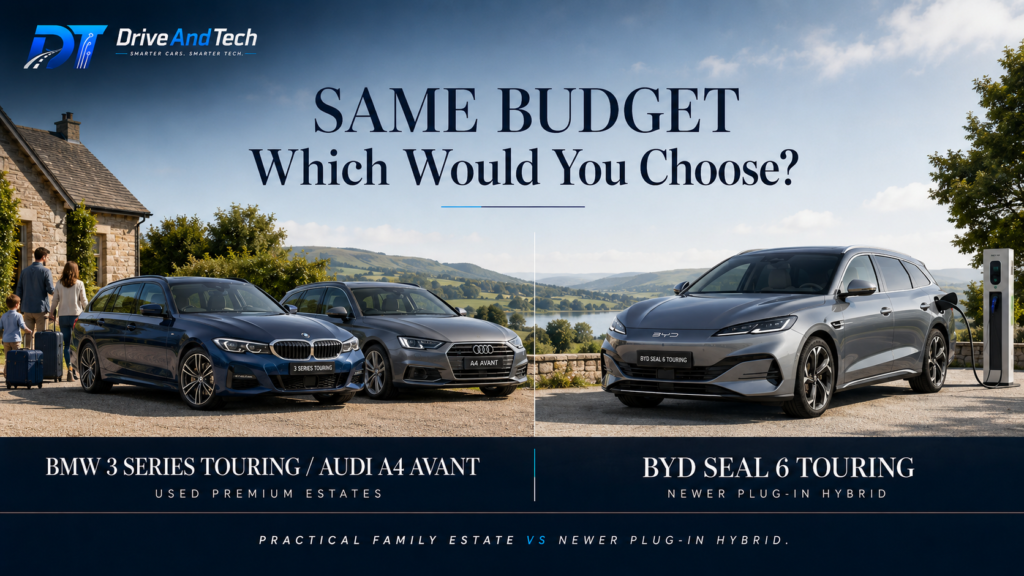
Comparison type: Direct estate-car alternative
Price-overlap zone: Approximately £22,000–£27,000
Powertrain comparison: Petrol, diesel or plug-in hybrid vs plug-in hybrid
Best suited to: Buyers choosing between an established premium estate and a much newer family estate with substantial warranty remaining
The BMW 3 Series Touring, Audi A4 Avant and nearly-new BYD Seal 6 Touring now overlap closely enough on the UK used market to create a genuine same-budget decision.
The BMW and Audi offer established premium branding, mature servicing networks and more predictable resale demand. The BYD offers much lower mileage, newer technology, plug-in hybrid flexibility and considerably more manufacturer warranty remaining.
For buyers who need a practical estate rather than an SUV, this is one of the strongest used premium versus nearly-new challenger comparisons in the guide.
DriveAndTech Market Price Guide (UK)
| Vehicle | Representative example | Likely price guide |
|---|---|---|
| BMW 330e M Sport Touring | 2023 plug-in hybrid | £20,000–£26,000 |
| BMW 320d/320i M Sport Touring | 2023 petrol or diesel | £25,000–£29,000 |
| Audi A4 Avant Black Edition | 2022 petrol or diesel automatic | £20,000–£24,500 |
| Nearly-new BYD Seal 6 Touring Boost | 2025 demonstrator/low mileage | £21,800–£23,000 |
| Nearly-new BYD Seal 6 Touring Comfort | Newer or very-low-mileage | £25,000–£28,500 |
The closest comparison is therefore a 2022 Audi A4 Avant or 2023 BMW 330e Touring at roughly £22,000–£26,000 versus a nearly-new BYD Seal 6 Touring at around £22,000–£27,000.
In some cases, the BYD can be both newer and cheaper.
What the BMW 3 Series Touring Gives You
The BMW remains the strongest driver-focused option.
Its advantages include:
- More engaging steering and handling
- Strong premium-brand appeal
- Established resale demand
- Mature dealer and specialist support
- Excellent motorway stability
- Petrol, diesel and plug-in hybrid choice
The 330e Touring is particularly relevant because, like the BYD, it offers electric driving for shorter journeys while retaining a petrol engine for longer trips.
However, buyers should check battery condition, charging equipment, service history and previous fleet use carefully.
The BMW is therefore the best choice for buyers who genuinely value the driving experience rather than simply wanting a premium badge.
What the Audi A4 Avant Gives You
The A4 Avant is the more understated premium choice.
Its strengths include:
- High perceived cabin quality
- Comfortable motorway refinement
- Familiar controls
- Established petrol and diesel engines
- Strong servicing knowledge
- Predictable used-market demand
- Practical estate-car packaging
The Audi may suit buyers who cover high motorway mileage or simply prefer conventional petrol or diesel refuelling without needing to think about regular charging.
It is older than the BYD, but its maturity can also be reassuring: buyers and garages already understand how the model behaves as it ages.
What the BYD Seal 6 Touring Gives You
The Seal 6 Touring’s biggest advantage is how much newer a car the same money can buy.
A nearly-new example may provide:
- Very low mileage
- Most of its manufacturer warranty remaining
- Plug-in hybrid flexibility
- Modern infotainment and safety technology
- Strong family practicality
- Lower immediate wear
- Electric driving for everyday journeys
The Boost version offers around 31 miles of WLTP combined electric range, while the larger-battery Comfort offers around 62 miles.
That makes the Comfort particularly attractive to buyers who can charge at home and complete most weekday journeys electrically.
As with any plug-in hybrid, the financial benefit depends heavily on charging regularly. A PHEV that is rarely plugged in carries additional weight and complexity without delivering its full efficiency advantage.
Space and Family Practicality
The BYD appears strongest on published luggage figures.
Approximate quoted capacities are:
- BMW 330e Touring: 410 litres
- Audi A4 Avant: 495 litres
- BYD Seal 6 Touring: up to 675 litres
The BYD therefore has a strong family-practicality argument, although different manufacturers may use different measurement methods.
Buyers should still inspect the actual load-floor shape, rear-seat folding arrangement, pushchair access and charging-cable storage rather than choosing solely on headline litres.
Interior Quality and Technology
The BMW and Audi retain an advantage in traditional premium presentation.
The BMW feels more driver-focused, while the Audi emphasises refinement, materials and familiarity.
The BYD counters with generous modern equipment, potentially including:
- Large infotainment display
- Apple CarPlay and Android Auto
- 360-degree camera
- Panoramic roof
- Wireless phone charging
- Heated and ventilated seats
- Electric tailgate
The distinction is straightforward:
The BMW and Audi may feel more premium. The BYD may provide more equipment for the money.
A test drive is therefore more useful than comparing specification sheets alone.
Warranty: A Major BYD Advantage
BYD’s UK warranty generally includes:
- 6 years/93,750 miles basic vehicle cover
- 8 years/93,750 miles drive-unit cover
- 8 years/125,000 miles battery cover
A 2025 Seal 6 Touring should therefore retain most of its original protection.
A 2022 Audi may have little original manufacturer warranty remaining, while a 2023 BMW is likely to lose its original cover considerably sooner.
This makes warranty one of the strongest objective reasons to consider the BYD.
Buyers should still verify first-registration date, servicing compliance, battery terms and whether previous demonstrator or accident use affects cover.
Running Costs and Long-Distance Use
All three cars can complete long journeys without depending entirely on public charging.
The BMW 330e and BYD use petrol once their usable electric range is depleted, while a conventional Audi petrol or diesel offers simple rapid refuelling.
The BYD may deliver the lowest day-to-day fuel costs when charged regularly at home and used mainly within its electric range.
The BMW 330e can deliver similar benefits, while an Audi diesel may still appeal to very high-mileage motorway drivers.
Premium German cars may expose owners to higher labour, suspension and drivetrain costs as they age. The newer BYD has more warranty protection, but insurance, tyres, specialist repairs, parts availability and depreciation can still be significant.
Depreciation and Resale
Depreciation is the BYD’s main weakness.
A Seal 6 Touring Boost that cost substantially more when new can already appear around the low-£20,000s as a demonstrator or nearly-new car.
For the second buyer, this creates an opportunity:
Much of the initial depreciation may already have occurred while most of the warranty remains.
The uncertainty is future resale.
BMW and Audi benefit from deeper used markets, familiar part-exchange values and much longer-established buyer demand.
The BYD therefore offers stronger immediate value but less predictable residual values.
What Could You Regret?
Choose the BMW and you may regret: higher mileage, less warranty, reduced 330e boot space or premium repair costs.
Choose the Audi and you may regret: buying an older discontinued model with little warranty when a much newer alternative costs similar money.
Choose the BYD and you may regret: uncertain resale values, less-established dealer support or finding its driving experience less rewarding than the German cars.
DriveAndTech Better-Value Choice
Nearly-New BYD Seal 6 Touring Boost
At roughly £22,000–£23,000, it combines very low mileage, strong practicality, plug-in hybrid flexibility and several years of remaining manufacturer cover.
For buyers who can charge regularly and plan to keep the car for several years, it offers exceptional immediate value.
DriveAndTech Premium Experience Choice
Used Audi A4 Avant Black Edition
Choose the Audi if cabin quality, motorway refinement and conventional long-distance ownership matter more than having the newest car.
DriveAndTech Driver’s Choice
Used BMW 3 Series Touring
Choose the BMW if steering, handling and driver involvement are genuine priorities.
Buyer Confidence
BMW 3 Series Touring: High
Best with complete servicing and careful battery and charging checks for the 330e.
Audi A4 Avant: High
Strongest with sensible mileage, full history and checks of transmission, suspension and emissions systems where relevant.
BYD Seal 6 Touring: Medium to High
Low mileage and long warranty support confidence, although resale values, parts support and dealer coverage remain less established.
DriveAndTech Verdict
This comparison demonstrates why buyers should look beyond the badge.
For approximately £22,000–£27,000, a used BMW or Audi offers established premium quality, stronger resale familiarity and mature servicing support.
A nearly-new BYD Seal 6 Touring can offer lower mileage, more warranty, greater quoted luggage capacity, newer technology and plug-in hybrid flexibility for similar or sometimes less money.
The BMW remains the driver’s choice.
The Audi remains the traditional premium-estate choice.
The BYD is the DriveAndTech value winner.
Choosing the BMW or Audi is entirely reasonable when their refinement, handling and established ownership ecosystem genuinely matter.
But buying one automatically because the badge feels safer, without comparing a substantially newer BYD with years of warranty remaining, would be exactly the kind of used-car badge trap this guide is designed to expose.
[Compare nearly-new estate and plug-in hybrid offers]
Suggested CTA: Compare current prices, mileage and remaining warranty before choosing between a used premium estate and a nearly-new alternative.
[Compare home EV charger quotes]
Suggested CTA: Check home-charging costs before buying a plug-in hybrid, as regular charging is essential to achieving the expected fuel savings.
Total Ownership Cost: The Numbers That Matter After Purchase
The asking price is only the starting point.
A used premium car and a new or nearly-new alternative can cost the same to buy but very different amounts to own over the next three to five years.
The most important ownership costs are:
- Depreciation
- Finance interest
- Insurance
- Servicing
- Tyres and brakes
- Fuel or electricity
- Road tax
- Repair exposure
- Warranty protection
The cheapest car to buy is not always the cheapest car to own.
Warranty vs Depreciation
This is usually the biggest trade-off.
The newer car often gives you:
- More manufacturer warranty
- Lower mileage
- Less previous wear
- Greater short-term repair certainty
The used premium car often gives you:
- Less exposure to early depreciation
- A lower current market value
- More established resale demand
- More predictable future part-exchange values
A long warranty reduces the risk of certain repair bills.
It does not protect you from depreciation.
Likewise, a used premium car may lose value more slowly but still expose the owner to expensive repairs once manufacturer cover ends.
Insurance
Do not assume the newer car will automatically be cheaper to insure.
Premium vehicles can be expensive because of:
- Performance
- Parts prices
- Larger wheels
- Advanced lighting
- Repair costs
- Theft risk
Newer electric or challenger-brand cars can also be expensive because of:
- Specialist repairs
- Battery procedures
- Parts availability
- Limited repair networks
- Expensive sensors and cameras
Always obtain insurance quotes for the exact registration before paying a deposit.
A £1,500 annual insurance difference can outweigh a relatively small purchase-price saving very quickly.
Servicing and Maintenance
Used premium cars may require more expensive:
- Labour
- Replacement parts
- Transmission servicing
- Suspension work
- Hybrid-system maintenance
- Diesel emissions repairs
Independent specialists can reduce these costs substantially on established brands.
A new or nearly-new alternative usually begins ownership with:
- Fresh tyres
- New brake components
- No overdue servicing
- Little mechanical wear
However, warranty does not mean maintenance is free.
The owner will still need to budget for scheduled servicing, tyres, brakes and other wear items.
Tyres and Brakes
This is an easy cost to overlook when buying used.
A premium car can appear competitively priced but already need:
- Four tyres
- Front brake discs and pads
- Rear brakes
- Wheel alignment
Large premium-sized tyres can be expensive.
Before buying, check:
- Tread depth
- Tyre age
- Uneven wear
- Matching brands
- Brake condition
- Remaining pad and disc life
A £2,000 purchase saving can disappear quickly if major wear items need replacing immediately.
Fuel, Hybrid or Electricity Costs
The correct powertrain depends on how the vehicle will actually be used.
Petrol may suit mixed driving and lower annual mileage.
Diesel can still make sense for regular long-distance motorway use.
Self-charging hybrid works well for buyers who want improved urban efficiency without plugging in.
Plug-in hybrid is most effective when charged regularly.
Electric is usually most attractive when the owner has dependable home or workplace charging.
Do not compare official fuel or electric figures alone.
Estimate the annual cost using your own:
- Mileage
- Journey pattern
- Charging access
- Fuel price
- Electricity tariff
A plug-in hybrid that is rarely charged may deliver disappointing economy.
An EV that relies mainly on expensive public rapid charging may save less than expected.
Finance: Compare Total Amount Payable
Finance can completely change which vehicle represents better value.
A new car may have:
- Lower APR
- Manufacturer deposit contribution
- Servicing incentives
A used premium car may have:
- Lower cash price
- Higher APR
- Larger deposit requirement
Never compare monthly payments alone.
Check:
- Cash price
- Deposit
- APR
- Agreement length
- Mileage allowance
- Optional final payment
- Fees
- Total amount payable
A low monthly figure can hide a large balloon payment.
Repair Risk
A used premium car may expose the buyer to expensive faults involving:
- Automatic transmission
- Suspension
- Electrical systems
- Infotainment
- Hybrid components
- Diesel emissions equipment
- Sensors and cameras
This does not mean these faults will occur.
It means the buyer should be financially prepared if they do.
A useful question is:
Could I comfortably pay for an unexpected £1,500–£3,000 repair without borrowing?
If the answer is no, stronger manufacturer warranty may be worth more than the premium badge.
Depreciation
Depreciation can be the largest ownership cost even though it never appears as a monthly bill.
For example:
A car bought for £30,000 and sold three years later for £20,000 has lost £10,000 in value before:
- Fuel
- Insurance
- Servicing
- Interest
- Repairs
Used premium cars may have already passed through their steepest early depreciation.
New cars begin much closer to the top of the depreciation curve.
Nearly-new cars can offer a useful middle ground because the first owner may already have absorbed a substantial initial loss while significant warranty remains.
Simple Ownership-Cost Comparison
Before choosing, compare both vehicles using the same ownership period.
| Cost category | Used premium car | New or nearly-new car |
|---|---|---|
| Purchase price | £— | £— |
| Finance interest | £— | £— |
| Expected depreciation | £— | £— |
| Insurance | £— | £— |
| Fuel or electricity | £— | £— |
| Servicing | £— | £— |
| Tyres and brakes | £— | £— |
| Road tax | £— | £— |
| Warranty cost | £— | £— |
| Repair reserve | £— | £— |
| Estimated total ownership cost | £— | £— |
This will usually tell you more than the badge or monthly finance payment ever will.
DriveAndTech Verdict
The used premium car may be cheaper through:
- Lower remaining depreciation
- Stronger resale demand
- Lower current purchase price
The newer car may be cheaper through:
- Fewer immediate repairs
- More warranty
- Lower starting wear
- More predictable maintenance
The correct comparison is:
Purchase price + finance + depreciation + running costs + realistic repair exposure.
That is the figure that should decide whether the badge is worth paying for.
Which Option Makes More Sense for You?
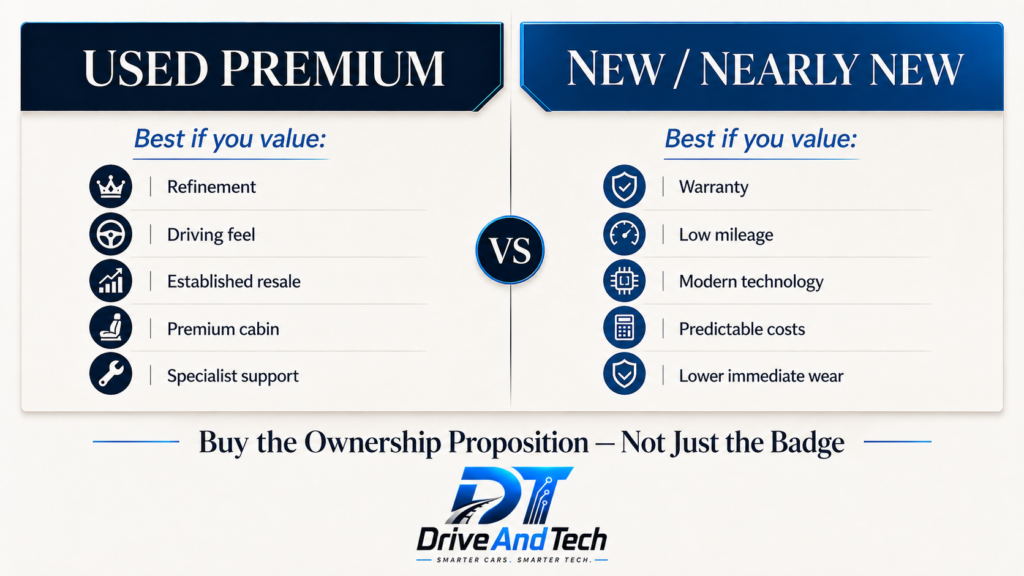
The best choice depends less on the badge and more on how you plan to use the car.
A used premium car can be the better purchase for one buyer and the wrong purchase for another with the same budget.
Choose the Used Premium Car When:
- You value refinement, comfort and driving quality
- The car has a complete service history
- Mileage is sensible for its age
- The price is clearly below the newer alternative
- You have access to a trusted specialist garage
- You can comfortably manage unexpected repairs
- You plan to sell again within a few years
- Strong resale demand matters to you
- You regularly cover long motorway journeys
- You genuinely prefer the car rather than simply wanting the badge
The strongest used premium purchase is usually a well-maintained example that has already absorbed much of its early depreciation but has not yet entered the expensive stage of ownership.
Choose the Brand-New or Nearly-New Car When:
- You prioritise warranty and ownership certainty
- The price difference is small
- You want very low starting mileage
- You intend to keep the car for several years
- You cannot easily absorb a large repair bill
- You want the latest safety and infotainment technology
- You prefer predictable servicing and maintenance
- You want to control the car’s history from the beginning
- The newer vehicle has good local dealer support
- Its powertrain fits your actual driving pattern
For many buyers, a nearly-new car offers the most balanced option because it combines:
- Lower mileage
- Substantial remaining warranty
- Modern equipment
- A discount from the original new price
- Less immediate wear than an older used vehicle
If You Drive Mostly on Motorways
A used premium petrol or diesel car may still make strong sense.
Long-distance drivers often benefit from:
- Better motorway refinement
- Comfortable seats
- Strong overtaking performance
- Fast refuelling
- Mature servicing support
A diesel may remain suitable for high annual mileage, provided the driving pattern supports proper emissions-system operation.
An EV can still work well for motorway use, but buyers should be realistic about:
- Charging stops
- Public charging costs
- Winter range
- Long-distance charging availability
If You Drive Mostly in Town
A newer hybrid or electric car may be more attractive.
Urban drivers may benefit from:
- Automatic driving
- Lower low-speed running costs
- Regenerative braking
- Quiet operation
- Modern parking technology
- Lower starting wear
Premium motorway refinement provides less practical value when most journeys are short and local.
If You Cannot Charge at Home
Be cautious about choosing an electric or plug-in hybrid vehicle purely because its official running costs look low.
Without convenient charging:
- Public charging may cost substantially more
- Plug-in hybrids may spend most of their time using petrol
- Charging can become inconvenient
- Expected savings may shrink
A self-charging hybrid or efficient petrol model may be a better fit.
If You Plan to Keep the Car for Many Years
Long-term buyers should place greater weight on:
- Low starting mileage
- Warranty
- Serviceability
- Parts availability
- Reliability evidence
- Powertrain durability
A newer car may have an advantage because the buyer starts ownership earlier in the vehicle’s life.
However, a proven used Toyota, Lexus or carefully selected premium model may still make more sense if its long-term reliability evidence is stronger.
If You Plan to Change the Car Again Soon
Short-term buyers should pay close attention to depreciation and resale.
A used premium car may be attractive because:
- Much of its initial depreciation has already occurred
- Demand is established
- Part-exchange values are easier to predict
A brand-new car may provide stronger warranty but lose more money if sold again after only two or three years.
If You Have Limited Emergency Savings
A new, nearly-new or manufacturer-approved used vehicle is usually the safer starting point.
The issue is not that a used premium car will definitely fail.
It is that the financial impact can be much greater if something does go wrong.
A buyer who cannot comfortably handle an unexpected repair should place more value on:
- Manufacturer warranty
- Lower mileage
- Approved-used cover
- Predictable servicing
- Roadside assistance
If Driving Enjoyment Matters
A used premium car may justify its higher ownership risk.
A BMW 3 Series, for example, may provide greater steering feel and chassis balance than a newer value-focused alternative.
If that difference matters every time you drive, it has genuine value.
If you rarely notice or care about those qualities, paying more for them may not make sense.
Quick Buyer Match
| Buyer priority | Better starting point |
|---|---|
| Prestige and refinement | Used premium car |
| Low repair risk | New or nearly-new car |
| Long motorway journeys | Premium petrol/diesel/hybrid |
| Mostly urban driving | Hybrid or EV |
| No home charging | Petrol or self-charging hybrid |
| Long-term ownership | Newer car or proven used model |
| Short-term ownership | Used premium car |
| Limited emergency savings | New, nearly-new or approved used |
| Driving enjoyment | Used premium car |
| Latest technology | New or nearly-new car |
| Strong resale confidence | Established used premium car |
| Maximum warranty | New or nearly-new car |
DriveAndTech Verdict
There is no universal winner.
The used premium car makes more sense when its refinement, condition and resale advantages are genuinely important to you.
The newer car makes more sense when lower mileage, warranty and ownership certainty are more valuable than the badge.
The best purchase is the one that matches:
- Your mileage
- Your budget
- Your repair tolerance
- Your charging access
- Your ownership period
- Your priorities behind the wheel
That is a much better decision-making framework than simply asking which badge looks more impressive.
10-Point Used Luxury Car vs New Car Buying Checklist
Before paying a deposit, compare the actual vehicles not just their badges, ages or monthly payments.
1. Confirm the Genuine Price Overlap
Make sure you are comparing cars that genuinely sit within the same budget.
Record:
- Asking price
- Dealer fees
- Delivery charges
- Discounts
- Finance contributions
- Total cash price
Avoid comparing an unusually cheap high-mileage premium car with a heavily discounted new alternative and treating that as typical.
2. Check the Total Finance Cost
If finance is involved, compare:
- Deposit
- APR
- Agreement length
- Monthly payment
- Mileage allowance
- Optional final payment
- Fees
- Total amount payable
The lowest monthly payment is not automatically the cheapest deal.
3. Confirm the Warranty Remaining
Check:
- Warranty start date
- Expiry date
- Mileage limit
- Transferability
- Servicing requirements
- Battery or hybrid-system cover
- Exclusions
A nearly-new car may have already used part of its warranty before you buy it.
4. Verify the Used Car’s History
For any used premium vehicle, check:
- Service history
- MOT history
- Mileage progression
- Accident or write-off history
- Outstanding finance
- Recall status
- Number of previous keepers
- VIN and V5C details
A desirable badge should never replace a proper history check.
5. Identify Maintenance Due Soon
Look for upcoming costs such as:
- Tyres
- Brake pads and discs
- Major servicing
- Transmission servicing
- Timing belt where applicable
- Suspension work
- MOT advisories
- Hybrid-system maintenance
A used car that is £2,000 cheaper can quickly lose that advantage if major work is due immediately.
6. Get Insurance Quotes Before Buying
Insurance can materially change which car is affordable.
Obtain quotes using the exact vehicle rather than relying on assumptions based on:
- Brand
- Engine size
- Fuel type
- Purchase price
A newer EV or challenger-brand car can sometimes cost more to insure than expected.
7. Estimate Future Depreciation
Ask what each vehicle may be worth after your intended ownership period.
Consider:
- Age
- Mileage
- Brand demand
- Powertrain
- Warranty remaining
- New-car discounts
- Model replacement
- Market popularity
A car with fewer repair bills can still cost more overall if it depreciates heavily.
8. Check Dealer and Parts Support
For newer or less established brands, confirm:
- Nearest authorised dealer
- Service availability
- Parts supply
- Warranty support
- Courtesy-car availability
- Roadside assistance
A long warranty is far more useful when it is backed by convenient and responsive support.
9. Match the Powertrain to Your Driving
Choose based on how you actually drive.
Mostly motorway: petrol, diesel or efficient hybrid may suit.
Mostly urban: hybrid or EV may work better.
Regular home charging: EV or plug-in hybrid becomes more attractive.
No home charging: petrol or self-charging hybrid may be simpler.
The wrong powertrain can turn an apparently efficient car into an expensive one.
10. Ask Whether the Badge Is Worth the Trade-Off
Before making the final decision, ask:
What am I giving up to get this badge?
That may include:
- Warranty
- Mileage
- Newer technology
- Lower repair exposure
- A more recent registration
Then ask:
What am I genuinely receiving in return?
That may include:
- Better refinement
- Stronger resale demand
- Better driving dynamics
- More established servicing support
- Greater ownership satisfaction
If the benefits clearly outweigh the trade-offs, the premium car may be worth it.
If they do not, the badge may be influencing the decision more than the vehicle itself.
DriveAndTech Final Check
Before buying, you should be able to answer four questions:
- What will this car really cost me over the next few years?
- What ownership risks am I accepting?
- What advantages am I receiving for the badge or newer registration?
- Which vehicle better matches the way I actually drive?
If you cannot answer those clearly, the purchase decision is not ready.
Frequently Asked Questions
Is it better to buy a used luxury car or a new car?
Neither is automatically better.
A used premium car may offer:
- Better refinement
- Stronger driving dynamics
- More established resale demand
- Lower remaining depreciation
A new or nearly-new car may offer:
- Lower mileage
- More manufacturer warranty
- Newer safety technology
- Lower immediate repair exposure
The better choice depends on the specific vehicles, their prices and how long you plan to keep them.
Are used luxury cars reliable?
Some are very reliable. Others are expensive to maintain even when they are mechanically sound.
Reliability depends on:
- Model
- Engine
- Transmission
- Age
- Mileage
- Service history
- Previous ownership
- Maintenance quality
The badge alone is not enough.
A well-maintained used premium car with a complete history may be a better purchase than a poorly supported newer alternative.
Is nearly new better value than brand new?
Often, yes.
A nearly-new car can combine:
- Low mileage
- Substantial manufacturer warranty
- Modern equipment
- A significant discount from the original new price
That can make it one of the strongest buying positions in the market.
However, buyers should confirm:
- First-registration date
- Previous use
- Warranty start date
- Accident history
- Whether it was a demonstrator
- Why it is being sold
Is manufacturer-approved used worth paying extra for?
It can be.
Approved-used programmes may include:
- Manufacturer-backed warranty
- Multi-point inspection
- Roadside assistance
- History checks
- Vehicle preparation
- Recall completion
- Clearer after-sales support
This can be especially valuable when buying a complex premium, hybrid or electric vehicle.
However, always compare the approved-used price with:
- Independent dealer prices
- Nearly-new alternatives
- Pre-registered stock
- Brand-new discounts
Sometimes approved-used pricing comes surprisingly close to a newer alternative.
How much should I keep aside for used premium-car repairs?
There is no single amount that suits every vehicle.
However, buyers should ideally retain enough money to cover immediate ownership costs such as:
- Tyres
- Brakes
- Servicing
- Suspension repairs
- Diagnostic work
- Insurance excess
For an older or more complex premium vehicle, a larger emergency reserve may be sensible.
If an unexpected £1,500–£3,000 repair would cause serious financial difficulty, stronger warranty protection may deserve greater priority.
Does a dealer warranty replace my consumer rights?
No.
A dealer warranty is additional protection.
It does not automatically replace the legal rights that may apply when a vehicle bought from a trader is faulty, misdescribed or not of satisfactory quality for its age, mileage, price and description.
Warranty documents should still be checked carefully because they can contain:
- Claim limits
- Exclusions
- Labour-rate limits
- Approved repairer requirements
- Diagnostic restrictions
A warranty and statutory consumer protection are not the same thing.
Is an electric car cheaper to own than a petrol car?
It can be, especially when charged mainly at home.
An EV may offer:
- Lower energy costs
- Fewer routine mechanical service items
- Quiet urban driving
However, total ownership cost also depends on:
- Insurance
- Depreciation
- Tyres
- Public charging
- Home-charger cost
- Repair support
- Future resale value
An EV that relies mostly on expensive rapid charging may not produce the same savings as one charged at home.
What is the best choice for most buyers?
For many buyers, the strongest middle ground is a carefully selected nearly-new car.
It can provide:
- Low mileage
- Substantial warranty
- Modern technology
- Lower immediate wear
- A meaningful discount from new
However, a well-maintained used premium car can still be the better purchase when it is clearly cheaper and offers genuine advantages in:
- Refinement
- Driving quality
- Resale confidence
- Support
- Ownership satisfaction
The best choice is the car whose total ownership proposition best matches your budget and driving needs.
Final Verdict: Used Luxury Car or New Car?
The used luxury car vs new car decision is not really about choosing prestige over practicality.
It is about deciding which type of value matters more to you.
A used premium car may give you:
- Better refinement
- Stronger driving dynamics
- More established resale demand
- Greater badge appeal
- Access to a wider specialist network
- Less exposure to the steepest early depreciation
A new or nearly-new alternative may give you:
- Lower mileage
- More manufacturer warranty
- Newer technology
- Less existing wear
- Greater short-term ownership certainty
- A more complete history from the start
Neither side wins automatically.
The used premium car becomes the better choice when it is in excellent condition, sensibly priced and supported by a complete history. If its comfort, driving quality and resale strength genuinely matter to you, accepting less warranty can be completely reasonable.
The newer car becomes the stronger choice when the price gap is small and the buyer values low mileage, warranty and predictable ownership more than the badge.
For many buyers, nearly new is the strongest middle ground.
A nearly-new vehicle may already have absorbed a large part of its first depreciation while still retaining much of its original manufacturer warranty. That combination can be especially attractive when the alternative is a used premium car with higher mileage and little warranty remaining.
The important point is that the badge itself is not the problem.
The trap begins when a buyer pays extra for familiarity without asking what they are receiving in return.
Before making the final decision, compare:
- Purchase price
- Total finance cost
- Mileage
- Warranty
- Service history
- Insurance
- Expected maintenance
- Depreciation
- Dealer support
- Practicality
- Driving experience
DriveAndTech Recommendation
Choose the used premium car when its refinement, condition and resale advantages clearly justify the additional ownership risk.
Choose the brand-new or nearly-new alternative when lower mileage, stronger warranty and predictable early ownership matter more to you.
And if both choices cost almost the same?
Do not buy the badge first.
Buy the vehicle that gives you the strongest combination of quality, protection and future value for the money you are actually spending.
Related DriveAndTech Guides
If you are still comparing options, these guides can help you narrow down the right car for your budget and ownership needs.
Best Used Cars Under £5,000 UK
A practical guide to dependable used cars for buyers who want strong value without moving into premium-car pricing.
Read next: Best Used Cars Under £5,000 UK
Most Reliable Used Cars in the UK
Compare used cars with strong reliability reputations, sensible running costs and good long-term ownership potential.
Read next: Most Reliable Used Cars in the UK
Best SUVs Under £10,000 UK
Explore affordable used SUVs offering family practicality, automatic options and manageable ownership costs.
Read next: Best SUVs Under £10,000 UK
Best Hybrid Cars Under £15,000 UK
Compare used hybrid cars that can reduce fuel consumption without requiring regular external charging.
Read next: Best Hybrid Cars Under £15,000 UK